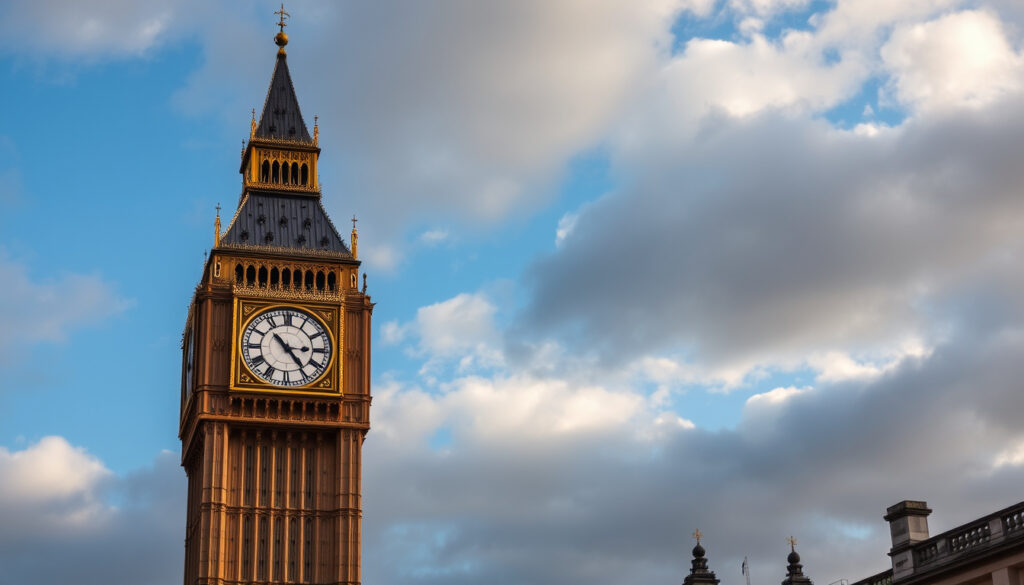
What Time Is It in the UK? Current Time & Clock Changes
If you’ve ever searched “what time is it in the UK” while trying to schedule a call or catch a live event, you already know the answer isn’t fixed—it flips twice a year with the clocks. This guide breaks down the current UK time, explains the difference between GMT and BST, and answers the most common time-related questions travelers and remote workers ask.
Standard time zone: Greenwich Mean Time (GMT) – UTC+0 ·
Daylight saving time: British Summer Time (BST) – UTC+1 ·
DST start: Last Sunday in March ·
DST end: Last Sunday in October ·
Current offset (example): BST (UTC+1) from late March to late October
Quick snapshot
- UK uses GMT (UTC+0) in winter and BST (UTC+1) in summer GOV.UK (official government guidance)
- Clocks go forward at 1:00 AM GMT on the last Sunday of March GOV.UK (official government guidance)
- Clocks go back at 2:00 AM BST on the last Sunday of October GOV.UK (official government guidance)
- The UK has a single time zone across England, Scotland, Wales and Northern Ireland GOV.UK (official government guidance)
- Future of daylight saving time: the UK government has reportedly discussed abolishing the twice-yearly change, but no legislation has been passed
- Exact second-by-second current time requires a live source such as Time.is or timeanddate.com
- Next change: Sunday 29 March 2026 — clocks forward at 1:00 AM GMT GOV.UK (official government guidance)
- Following change: Sunday 25 October 2026 — clocks back at 2:00 AM BST GOV.UK (official government guidance)
- First introduced in 1916 via the Summer Time Act (GOV.UK (official government guidance))
- Current arrangement standardised by the British Summer Time Act 1972 Wikipedia (community-reviewed encyclopedia)
- Check the current time using a live clock like Time.is (real-time clock service)
- Prepare for the loss of one hour of sleep when clocks spring forward in March (Time.is (real-time clock service))
- Bookmark GOV.UK’s clock-change page for official date confirmation each year (Time.is (real-time clock service))
Five key facts capture the essentials of UK timekeeping, from offsets to the relationship with Ireland.
| Fact | Details |
|---|---|
| Official time zone names | Greenwich Mean Time (GMT) / British Summer Time (BST) |
| UTC offsets | GMT = UTC+0, BST = UTC+1 GOV.UK (official government guidance) |
| Next DST change | March 30, 2025 (clocks forward) Royal Museums Greenwich (national maritime museum) |
| Time difference with New York (typical) | 5 hours (UK ahead) during most of the year |
| Time difference with Ireland | 0 hours (same) — both islands observe identical time year-round |
What time is it in the UK just now?
Current UK time hinges on the season. From the last Sunday in March to the last Sunday in October, the UK runs on British Summer Time (BST), which is one hour ahead of Coordinated Universal Time (UTC+1). The rest of the year it uses Greenwich Mean Time (GMT), or UTC+0 GOV.UK (official government guidance).
What is the current UK time in GMT?
- If the UK is on BST (summer), the GMT equivalent is one hour behind. For example, 14:00 BST = 13:00 GMT.
- During winter (GMT period), the displayed local time is already GMT.
- Live services such as Time.is automatically show the correct offset with seconds and AM/PM.
What time is it in London, UK?
London uses the same time as the rest of the United Kingdom. There are no regional time zones within the country GOV.UK (official government guidance). Checking “time in London” gives you the current UK time.
What time is it in the UK with seconds?
For a real-time display including seconds and AM/PM, visit Time.is/United_Kingdom or 24timezones.com. Both services update every second and indicate whether BST or GMT is currently in effect.
What time is it in the UK now (AM/PM)?
Live clocks from the same sources above show the time with a 12-hour AM/PM format by default. They also display the current DST status and UTC offset. The Royal Museums Greenwich notes that BST effectively gives the UK a UTC+1 offset during the summer months.
Anyone checking UK time for a call or deadline should always look up the current offset rather than guessing. A single Google search won’t show you the transition date — only a live site will give you the exact seconds.
The implication is simple: the answer to “what time is it in the UK” depends entirely on the date. Bookmark a live clock for precision.
When do the clocks change?
Three key dates matter: the spring forward in March, the fall back in October, and the overnight moment when the switch happens.
Do clocks change in the UK tonight?
- Check the next scheduled date: clocks change on the last Sunday of March and the last Sunday of October GOV.UK (official government guidance).
- If today falls on that Sunday, the answer is yes. The change always occurs overnight into Sunday morning.
Do clocks go forward in the UK tonight?
Clocks go forward (spring forward) at 1:00 AM GMT on the last Sunday of March, shifting to 2:00 AM BST. In 2026, that’s Sunday 29 March Visit London (official tourism site).
Do we gain or lose an hour on Sunday?
On the spring-change Sunday, you lose one hour of sleep because the clocks jump from 1:00 AM to 2:00 AM. On the autumn-change Sunday, you gain an hour when they fall back from 2:00 AM to 1:00 AM GMT. The Royal Museums Greenwich recommends the mnemonic “spring forward, fall back” to remember the direction Royal Museums Greenwich (national maritime museum).
Your smart devices update automatically, but analogue clocks, car dashboards, and microwaves will be wrong until you manually set them. Forgetting the spring change means arriving an hour late to Sunday plans.
The catch: the change always happens early Sunday morning, so the disruption is minimal for most people. But anyone working night shifts or with international clients needs to check the exact date each year.
Is UK and Irish time the same?
Yes — and this is one of the least-known certainties for travelers between the two islands.
What time is it in Ireland, UK right now?
- The Republic of Ireland and the United Kingdom always share the same time, because Ireland also observes GMT in winter and IST (Irish Summer Time, equivalent to BST) in summer Wikipedia (community-reviewed encyclopedia).
- Northern Ireland, part of the UK, naturally follows the same clock as the Republic.
- There is never a time difference between any city in Ireland and any city in the UK — not during DST transitions, not during standard time.
The trade-off: if you’re scheduling a call between Dublin and London, you never need to calculate a time difference. The two countries deliberately harmonised their DST schedules years ago.
Is the UK 4 or 5 hours ahead?
This question usually refers to the time difference between the UK and the US East Coast. The answer changes depending on both countries’ DST calendars.
Time difference between London and New York
- Most of the year the UK is 5 hours ahead of New York. For example, when the UK is on BST (UTC+1) and New York is on EDT (UTC-4), the gap is 5 hours.
- During the brief two-week overlap when the US has already switched to DST but the UK hasn’t (or vice versa in autumn), the difference narrows to 4 hours 24timezones.com (time zone reference site).
How does US DST affect the offset?
The US begins DST on the second Sunday of March — usually two weeks before the UK. So from the second Sunday in March until the last Sunday in March, the UK is only 4 hours ahead of New York. Similarly, the US ends DST on the first Sunday of November, while the UK ends BST on the last Sunday of October, creating another short 4-hour window.
For anyone scheduling transatlantic meetings, the safe rule is to assume 5 hours ahead of New York during UK summer time and 5 hours ahead during UK winter too — except for those two brief transition windows. Check the current date to be sure.
Why this matters: a 5-hour difference means a 9 AM UK call is 4 AM in New York; a 4-hour difference makes it 5 AM. That extra hour changes what’s reasonable for a morning meeting.
Do we gain or lose an hour on Sunday?
This is asked most often on the weekend of a clock change. Here’s the concrete effect:
- Last Sunday in March — clocks go from 1:00 AM to 2:00 AM. You lose one hour of that night. The next day, sunrise and sunset are one hour later.
- Last Sunday in October — clocks go from 2:00 AM to 1:00 AM. You gain one hour. Sunrise and sunset happen one hour earlier.
The Royal Museums Greenwich confirms that the spring change is commonly called “spring forward” and the autumn change “fall back” Royal Museums Greenwich (national maritime museum).
For parents with young children or shift workers, the lost hour in March can be tougher than the gained hour in October. Plan your Sunday accordingly.
“The UK switches between GMT (UTC+0) in winter and BST (UTC+1) in summer — a system that has been in place, with minor tweaks, since 1916.”
— Gwilym Lockwood, writing on how clock changes work Gwilym Lockwood (independent writer)
“On the last Sunday of March, at 1:00 AM GMT, the clocks spring forward by one hour to 2:00 AM BST, marking the start of British Summer Time.”
— Royal Museums Greenwich (national maritime museum)
“The official GOV.UK page lists 2026 clock-change dates as 29 March and 25 October, giving individuals and businesses reliable notice.”
— GOV.UK (official government guidance)
instagram.com, instagram.com, en.wikipedia.org, forum.arduino.cc, mapsofworld.com, greenwichmeantime.com
Frequently asked questions
Does the UK observe daylight saving time?
Yes. The UK switches between GMT (standard time) in winter and BST (daylight saving time) in summer. The change happens on the last Sunday of March and the last Sunday of October GOV.UK (official government guidance).
What is the difference between GMT and BST?
GMT (Greenwich Mean Time) is UTC+0 and is used from late October to late March. BST (British Summer Time) is UTC+1 and is used during the summer months. BST gives an extra hour of daylight in the evening Royal Museums Greenwich (national maritime museum).
Why is the UK sometimes 4 hours ahead of New York?
The typical difference is 5 hours. It becomes 4 hours for about two weeks in March and another two weeks in October/November because the US starts and ends DST on different dates than the UK 24timezones.com (time zone reference site).
Do Scotland and England use the same time zone?
Yes. The entire United Kingdom — England, Scotland, Wales and Northern Ireland — uses the same time zone (GMT/BST). There are no regional variations GOV.UK (official government guidance).
What time zone does the UK use in winter?
Greenwich Mean Time (GMT), which is UTC+0. The winter period runs from the last Sunday in October to the last Sunday in March GOV.UK (official government guidance).
How do I know if the UK is currently on GMT or BST?
Check a live service such as Time.is or 24timezones.com. These sites display the current offset and DST status. Alternatively, note the month: BST runs from late March to late October.
Is the time in the UK the same as in Ireland?
Yes. Ireland uses GMT in winter and IST (Irish Summer Time, equivalent to BST) in summer. There is never any time difference between the two countries Wikipedia (community-reviewed encyclopedia).
Related reading
- Football on TV Today: Live Matches & Channels UK — schedules tied to UK time
- Lunar Eclipse September 7, 2025: Time & Visibility in Ireland — Ireland shares the same time zone as the UK
For anyone in the UK scheduling international calls, planning travel, or just setting an alarm, the key takeaway is this: remember the last Sundays of March and October. The rest of the year, the UK runs on a predictable two-offset system that lines up perfectly with Ireland and only briefly drifts from the standard US gap. Bookmark the official GOV.UK page to stay updated on exact dates year after year.
More related posts
 Vivienne Westwood Wedding Dress: Cost, Styles, Celebrity Wearers
 Isaiah 54:17 Meaning: No Weapon Formed Against You Shall Prosper
 How Fast Can a Cheetah Run? Speed Facts & Comparisons
 How Many Square Feet in an Acre? 43,560 Sq Ft + Dimensions
 Sleepy Girl Mocktail Recipe – Simple Ingredients for Better Sleep
 What Is the Constitution – Definition, History & Key Principles
 Nivea vs Garnier for Beginners: Which Brand to Pick
 New Homes for Sale – Texas Prices and Buying Guide
