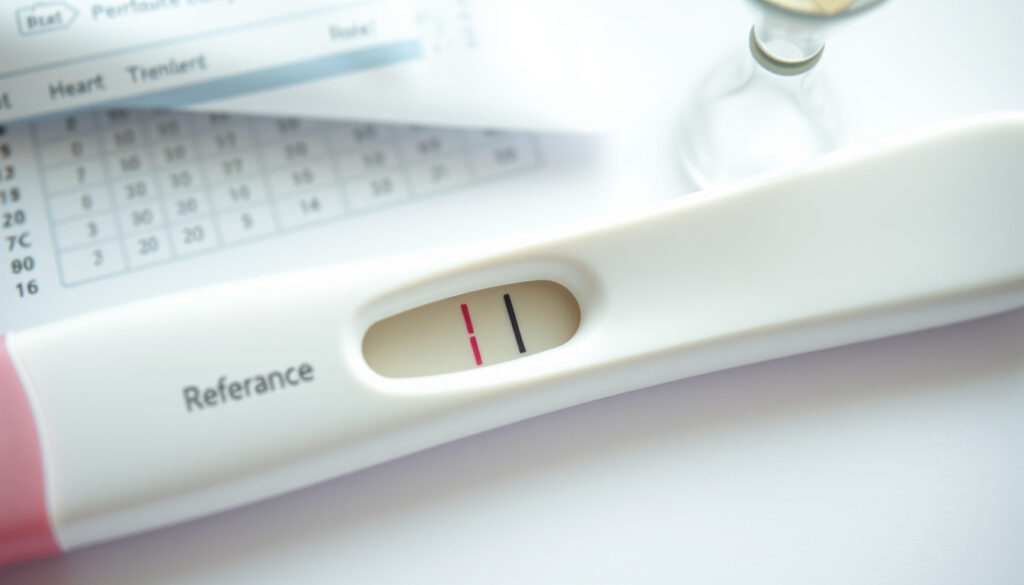
False Positive Pregnancy Test: Causes & Odds
You take the test, wait the required minutes, and see two lines. But sometimes those lines don’t mean pregnancy. False positives are rare—less than 1% of home tests—but when they happen, they can raise serious medical questions. This article breaks down the odds, the biological and chemical causes behind a false positive, and exactly what steps to take next.
False positive rate: <1% of home pregnancy tests ·
Standard hCG detection threshold: 25 mIU/mL ·
Most common cause of false positive: Recent pregnancy loss (chemical pregnancy or miscarriage) ·
Time for hCG to clear after early loss: Up to 2 weeks ·
Accuracy of digital pregnancy tests: >99% when used correctly
Quick snapshot
- False positive rate <1% (NHS UK national health authority)
- Recent pregnancy loss is the most common cause (Mayo Clinic leading US medical center)
- Blood test confirms pregnancy definitively (Mayo Clinic)
- Exact prevalence from specific medications
- Whether some over-the-counter supplements affect results
- Long-term impact of rare hCG-secreting tumors
- Exact clearance time varies by individual
- hCG clears within 2–3 weeks after early loss (Healthline medically reviewed publisher)
- Retest after 48 hours for confirmation (NHS)
- Repeat test with a different brand
- Visit doctor for blood hCG test
- Ultrasound if symptoms persist
Six facts that matter, one pattern: the majority of false positives trace back to hCG from a recent pregnancy loss or a medical condition, not a test defect.
| Fact | Value |
|---|---|
| Typical false positive rate | <1% |
| hCG threshold for most home tests | 25 mIU/mL |
| Most common cause | Recent pregnancy loss (chemical pregnancy) |
| Time for hCG to clear after early loss | Up to 2–3 weeks |
| Accuracy of digital tests | >99% when used correctly |
| False positive due to medication | Only if medication contains hCG (e.g., some fertility drugs) |
The implication: a false positive is rarely a fluke. It usually points to something real—a recent loss, a medication, or a medical condition—that deserves a medical conversation, not just a second test.
What are the odds you get a false positive pregnancy test?
Statistical likelihood of a false positive
- The NHS states home pregnancy tests are accurate when used correctly, and a positive result is “almost certainly correct” (NHS UK national health authority).
- Clearblue, a major test manufacturer, reports false positives occur in less than 1% of tests (Clearblue pregnancy test manufacturer).
- By comparison, false negatives are more common—especially when testing early—because hCG levels may still be below the 25 mIU/mL detection threshold (NHS).
Why false positives are rare: pregnancy tests are designed to detect hCG, a hormone produced almost exclusively during pregnancy. The test antibodies target a specific subunit of hCG, making cross-reactivity with other hormones unlikely. The low rate reflects this biological specificity.
A woman who sees a positive line has a 99+% chance of being pregnant according to the test. But if the pregnancy ends early—a chemical pregnancy—she may never know she was pregnant, only that the test “turned negative.” That’s the most common false positive story, and it’s biologically real.
The trade-off: the test’s accuracy creates a psychological shock when a false positive does occur. Understanding the odds helps put that shock in perspective—it’s not the test failing, it’s the body changing.
What causes a false positive pregnancy test?
Recent pregnancy loss (chemical pregnancy, miscarriage)
- After a fertilized egg implants, the body begins producing hCG. If the pregnancy ends very early—a chemical pregnancy—hCG levels rise enough for a positive test before dropping (Healthline).
- The Mayo Clinic notes a false positive “might happen if you had a pregnancy loss soon after the fertilized egg attached to the uterine lining” (Mayo Clinic).
- hCG can remain detectable for up to 2–3 weeks after a miscarriage, abortion, or childbirth (Clearblue; Bass Medical Group editorial).
Medications containing hCG
- Some fertility treatments—like injectable hCG used to trigger ovulation—can cause a false positive for up to two weeks after the last dose (Clearblue; Bredbury Medical Centre NHS).
- Weight-loss medications containing hCG may also produce a false positive, though these are less common.
- The Mayo Clinic lists “certain medications” including fertility drugs as possible interferers (Mayo Clinic).
Medical conditions (ovarian cysts, pituitary tumors, etc.)
- Ovarian cysts and pituitary tumors can produce hCG or hCG-like molecules (Clearblue lists rare ovarian cysts as a possible cause).
- Gestational trophoblastic disease, including molar pregnancy, can raise hCG to very high levels (Healthline; PubMed Central peer-reviewed medical literature).
- Certain malignancies—including lung, breast, and ovarian cancers—can secrete hCG (PubMed Central).
Interference from proteins or antibodies
- Human anti-mouse antibodies (HAMA) and heterophilic antibodies can cross-react with test antibodies, producing a false positive (PubMed Central).
- A serious urinary tract infection can occasionally cause a false positive, possibly due to leukocytes in the urine (Gloucestershire Hospitals NHS Foundation Trust).
- Expired or defective test kits are also listed as a possible cause (OhioHealth hospital network).
What do false positive lines look like?
Distinguishing faint true positives from evaporation lines
- True positive lines are colored—pink, blue, or red—depending on the test brand. The color comes from the dye bound to hCG.
- Evaporation lines, which appear when urine dries on the test strip after the read window, are usually colorless or gray. They lack the dye that indicates a true reaction (Healthline).
- An evaporation line does not mean the test is positive. It’s a technical artifact.
Characteristics of a false positive line (color, width, timing)
- False positives from actual hCG (e.g., from a chemical pregnancy or medication) produce a full-strength colored line—same as a true positive. There is no visual difference.
- Digital pregnancy tests remove the interpretation step: they display “Pregnant” or “Not Pregnant” in words, reducing the risk of misreading a faint line (Clearblue reports digital tests are >99% accurate when used correctly).
- If the line appears after the recommended read window (typically 3–5 minutes), it’s likely an evaporation line, not a positive result.
The pattern: the line itself can’t tell you if it’s a false positive. Only the context—your medical history, timing, and follow-up tests—can. That’s why digital tests help but don’t solve the biological question.
If you see a faint line within the read window, treat it as a positive until proven otherwise. The only way to know if it’s a false positive is to confirm with a blood test and track whether the line fades over 48 hours.
Is it possible to get a positive pregnancy test and not be pregnant?
Biological vs. technical false positives
- Yes—if the test detects hCG from a source other than a current, viable pregnancy. This is a biological false positive.
- A technical false positive occurs when the test is misread, expired, or defective. These are rarer when instructions are followed (NHS notes positive results are “almost certainly correct” when instructions are followed).
- Ectopic pregnancy still produces hCG—it’s a pregnancy, just in the wrong place. A positive test from an ectopic is not a false positive, but it requires urgent medical care (CCRM Fertility clinic).
Rare but possible scenarios
- Molar pregnancy: abnormal tissue grows instead of a fetus and secretes hCG (Healthline).
- Menopause: perimenopausal women may have slightly elevated hCG levels (PubMed Central).
- hCG-secreting tumors: rare but documented (PubMed Central).
The catch: a positive test is biologically meaningful even when you’re not pregnant in the ordinary sense. The hCG tells a story—it’s up to a doctor to read it.
How do I know if it’s a false positive pregnancy test?
Steps to confirm: retest, blood test, ultrasound
- Step 1: Repeat the test in 48 hours with a different brand. If the line disappears or weakens, it was likely a chemical pregnancy or transient hCG (Healthline).
- Step 2: Visit a doctor for a quantitative blood hCG test. Blood tests are more sensitive and precise than urine tests (Mayo Clinic).
- Step 3: If the blood hCG level is abnormal or doesn’t rise appropriately, an ultrasound can check for ectopic pregnancy, molar pregnancy, or other causes (CCRM Fertility).
When to see a doctor
- Any positive test followed by pelvic pain, bleeding, or dizziness—these could signal an ectopic pregnancy (CCRM Fertility).
- A positive test that persists over several days without other pregnancy signs.
- History of fertility treatments: your doctor needs to know if hCG was part of your protocol (Clearblue).
- Previous miscarriage or ectopic pregnancy: a positive test requires early monitoring.
The implication: the test is a starting point, not a verdict. A structured confirmation path—retest, blood test, imaging—turns uncertainty into actionable information.
What’s clear and what’s not
Confirmed facts
- False positive rate is <1% (NHS)
- Recent pregnancy loss is a common cause (Mayo Clinic)
- Evaporation lines are not true positives (Healthline)
- Blood test is definitive (Mayo Clinic)
What’s unclear
- Exact prevalence of false positives from specific medications
- Whether some over-the-counter supplements influence test results
- Long-term impact of rare hCG-secreting tumors
- Exact clearance time varies by individual
Expert perspectives on false positives
False positive pregnancy tests are rare, occurring less than 1% of the time.Clearblue (pregnancy test manufacturer)
A false-positive might happen if you had a pregnancy loss soon after the fertilized egg attached to the uterine lining.Mayo Clinic (leading US medical institution)
User error is among the most common reasons for a false positive, including testing too soon after a miscarriage or abortion.Healthline (medically reviewed health publisher)
Many factors can interfere with test results, including human anti-mouse antibodies and leukocytes in urine.PubMed Central (peer-reviewed medical literature database)
For anyone facing a surprising positive test, the choice is clear: retest within 48 hours using a fresh kit, and if the result remains positive, seek a blood test from a healthcare provider. The difference between a false alarm and a real pregnancy is rarely more than a few days and a lab visit.
Understanding the causes of false positive pregnancy tests can help you distinguish between a true positive and a test error.
Frequently asked questions
Can a false positive pregnancy test happen after a miscarriage?
How long does hCG stay in your system after a miscarriage?
Can birth control pills cause a false positive pregnancy test?
Can ovarian cysts cause a false positive pregnancy test?
What should I do if I get a false positive pregnancy test?
Can ectopic pregnancy cause a false positive?
Are digital pregnancy tests less likely to give false positives?
For readers looking to understand more about fertility and reproductive health, check out our guide on Can You Get Pregnant When You’re Not Ovulating? and the broader context of how medications affect the body in How Does Semaglutide Work?
More related posts
 Blake Fielder-Civil Now: What Happened After Amy Winehouse Died
 Israel Attacks Iran Today: Latest Updates on the Conflict
 What Does BCE Mean? | BCE Meaning and Difference from BC
 System of a Down Tour 2026: Dates, Tickets & UK Shows
 What Year Was 9/11? 2001 Attacks: Death Toll & Survival Facts
 Kelly Bishop Movies and TV Shows – Complete Filmography and Best Roles
 Resorts World Las Vegas Guide: Buffets, Budget & Celebrity Stays
 Sun Mountain Golf Bags Review: Worth the Hype
