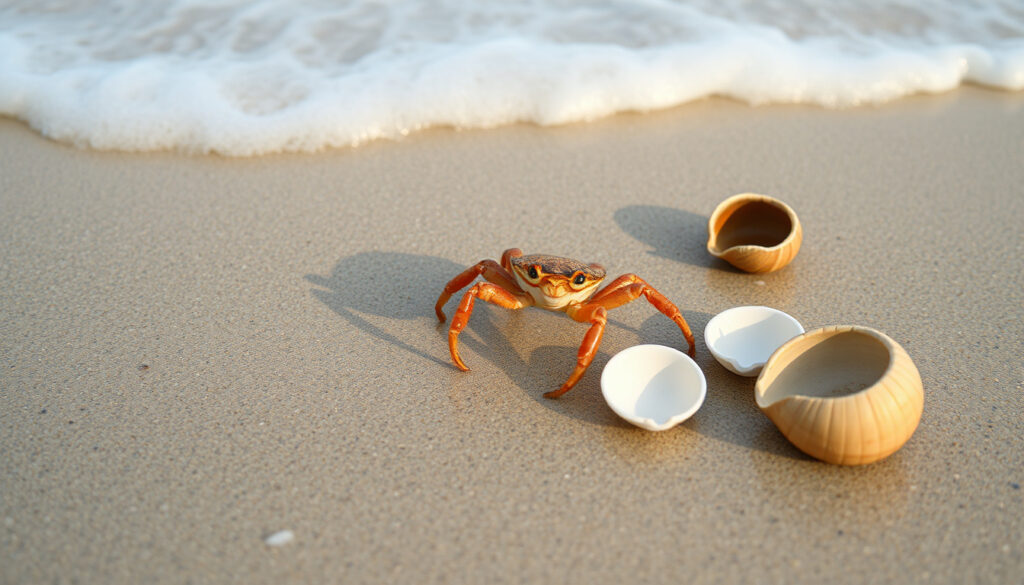
Hermit Crab Without Shell: Survival, Care & What to Do
If you’ve ever spotted your hermit crab crawling around without its shell, your heart probably skipped a beat. That exposed, squishy body looks impossibly fragile—and rightfully so. A hermit crab without its shell isn’t just uncomfortable; it’s in genuine danger. The good news: with quick, informed action, you can give your crab a real chance at recovery.
Vulnerability without shell: Soft abdomen exposed to predators · Main risk: Exoskeleton dries out quickly · Pet care source: Crab Street Journal emergency guide recommends immediate action · Survival factor: Needs new shell promptly
Quick snapshot
- Shell protects soft abdomen — Smithsonian Ocean
- Stress causes evacuation — Crab Street Journal emergency guide
- 10+ years with proper care — PetMD veterinary resource
- Exact survival hours without data
- Species-specific tolerance variations
- Shell loss common upon purchase — Crab Street Journal emergency guide
- Molting recovery: days to weeks — LHCOs molting guide
- Offer clean shells immediately
- Monitor tank temperature and humidity
| Parameter | Value | Source |
|---|---|---|
| Shell function | Protects soft abdomen | PetMD veterinary resource |
| Without shell risk | Quick drying and death | Crab Street Journal care blog |
| Minimum shells per crab | 3-5 | PetMD veterinary resource |
| Temperature warm end | 80-82°F | Crab Street Journal care blog |
| Temperature cool end | 72-75°F | Crab Street Journal care blog |
| Humidity range | 70-80% | LHCOs care standards |
| Saltwater specific gravity | 1.021-1.026 | PetMD veterinary resource |
| Substrate depth minimum | 6 inches | PetSmart retail care guide |
| Lifespan with proper care | 10+ years | PetMD veterinary resource |
| Habitat minimum | 10-gallon tank (1-2 crabs) | PetMD veterinary resource |
Can hermit crabs survive without a shell?
A hermit crab without its shell is in immediate mortal danger. Unlike turtles or armadillos, hermit crabs don’t grow their own protective armor—they depend entirely on empty snail shells scavenged from their environment. PetMD’s veterinary care sheet confirms that hermit crabs cannot produce their own shells and must rely on these borrowed homes for survival.
Risks of exposure
- The soft, curled abdomen that normally rests inside a shell becomes completely exposed to predators
- Without shell insulation, the exoskeleton loses moisture rapidly—the crab essentially dries out from the inside
- Physical damage from accidental contact with tank decorations, substrate, or tank mates becomes a serious threat
The implication: every minute without a shell increases the risk of irreversible damage or death. According to Crab Street Journal’s emergency guide, shell evacuation signals severe distress—often triggered by environmental factors rather than simple behavior.
Short-term survival factors
The Crab Street Journal explicitly states that a hermit crab that has left its shell is telling you it is in distress. Time is not on your side. The moment you notice your crab out of its shell, every minute of delay increases the risk of permanent damage or death.
Pet store crabs often arrive shell-less due to shipping stress. If you buy a crab in this condition, you need to act within minutes, not hours. Have shells ready before you bring the crab home.
What to do if your hermit crab is out of his shell?
When a hermit crab abandons its shell, the response protocol matters more than anything else. Panicked handling or wrong assumptions about “what to do” can kill a crab that might have survived with proper steps. According to Crab Street Journal’s detailed emergency guide, the process is straightforward but requires attention to specific details.
Immediate steps
- Do not forcibly try to push the crab back into its original shell—this often causes injury
- Prepare a small, shallow container with dechlorinated water and place the shell inside
- If the original shell is available, boil it in dechlorinated water for 5 minutes to remove any irritants (sand, old food, mites), then cool completely before presenting it
- Moisten the crab’s body gently with dechlorinated water using a spray bottle set to fine mist
- Cover the container loosely to retain humidity and place it in a quiet area away from direct light
The pattern: patience is critical. Rushing the process or forcing a shell onto a crab can cause fatal injury.
Provide shell options
PetMD recommends providing each hermit crab with at least 3-5 empty shells in assorted sizes to accommodate growth and shell-switching behavior. Never offer painted or glazed shells—the Hermit Crab Association warns these coatings are toxic even when labeled as non-toxic.
Natural shells are safer but may be harder to source quickly. Painted shells look appealing in pet stores but carry real toxicity risk—always choose plain natural shells for shell-less crabs in recovery.
How long can a hermit crab survive without a shell?
The uncomfortable truth is that no scientific study has pinned down an exact survival window for shell-less hermit crabs, and pet care sources consistently warn against relying on estimates. What experts do agree on is that the drying process begins immediately and moves fast. The Crab Street Journal notes that humidity levels in your tank directly influence how quickly a shell-less crab deteriorates.
Time limits
- In dry conditions, a hermit crab can begin showing signs of dehydration within 30 minutes to 2 hours
- At humidity below 70%, the crab’s gills cannot function properly, causing respiratory distress
- Most emergency guides suggest that without intervention within the first few hours, survival odds drop significantly
Influencing factors
Temperature plays a critical role. Crab Street Journal specifies optimal temperature ranges: warm end 80-82°F, cool end 72-75°F, and notes that temperatures that are too hot directly cause shell abandonment. If your tank runs hot, a shell-less crab loses moisture even faster.
If your crab’s body appears shriveled or pale, irreversible damage may already be occurring. Act immediately upon discovery, not when you “get around to it.”
Why do hermit crabs need shells?
The answer goes beyond simple protection. Hermit crabs evolved their shell-swapping behavior over millions of years, and their entire physiology adapted around having that portable home. Understanding why they need shells helps you understand why going without is so dangerous.
Protection role
PetMD describes hermit crabs as omnivorous creatures with soft, curled abdomens that are completely vulnerable without shell coverage. Unlike the hard exoskeletons protecting their front portions, their rear segments remain soft and susceptible to injury.
- Shell protects the vulnerable gills used for breathing on land
- Shell retains moisture critical for the crab’s respiratory function
- Shell provides leverage for movement and climbing
- Shell offers camouflage from predators in their natural coastal habitats
What this means: the shell isn’t optional equipment—it’s structural to how a hermit crab functions.
Natural behavior
Hermit crabs naturally seek larger shells as they grow. The Hermit Crab Association’s care PDF notes that crabs will literally fight over desirable shells—a behavior called “shell jacking.” According to Happy Hermie’s care guide, shell jacking during fights can cause limb loss as crabs use claws to pull competitors’ limbs.
Shells are not just protection—they are identity. A crab without a shell cannot perform basic survival behaviors like climbing, burrowing, or even feeding properly.
What stresses out hermit crabs?
Stress is not a vague concept for hermit crabs—it has specific, identifiable triggers. The Crab Street Journal identifies four primary causes of shell abandonment, and correcting these is essential both for recovery and prevention.
Shell-related stress
- Wrong size: A shell too small causes constant pressure; too large makes movement difficult
- Irritants inside: Sand, decomposing food, or mites inside the shell drive the crab out
- Shell fights: Aggressive tank mates forcibly removing crabs from shells
- Growth needs: A crab outgrowing its current shell will search for a new one desperately
The catch: shell stress is often a symptom of deeper problems—solve the environment first.
Other causes
Environmental factors often trigger stress that manifests as shell abandonment. Crab Street Journal specifically warns that temperatures that are too hot cause shell abandonment, and humidity below 70% creates a suffocation sensation.
- Temperature extremes—either too hot or too cold
- Inadequate humidity causing gill dysfunction
- Loud vibrations or frequent tank disturbances
- Inappropriate substrate preventing natural burrowing during rest
- Poor diet leading to protein deficiency and weak molts
The LHCOs molting guide notes that chronic protein deficiency causes poor molts and limb loss—making shell-seeking behavior more frequent in malnourished crabs.
Emergency care steps
Follow this sequence immediately upon discovering a shell-less hermit crab. Each step addresses a specific threat identified in verified pet care sources.
- Assess and contain — Place the crab in a small, shallow container with damp substrate (not wet). Do not leave it on a flat surface where it can roll or injure itself.
- Check humidity — Ensure container humidity is high. Mist with dechlorinated water if needed. Crab Street Journal notes humidity below 70% creates suffocation sensations.
- Prepare shell options — Boil 3-5 natural shells (not painted) in dechlorinated water for 5 minutes. Cool completely. Arrange them opening-upward near the crab.
- Introduce shells — Do not force the crab into any shell. Place shells at varying distances and orientations. The crab will choose when ready.
- Create recovery space — Once the crab accepts a shell, keep it isolated in a small container with familiar substrate, fresh dechlorinated water, and a hide. Monitor for 24-48 hours.
- Gradual tank reintegration — Return the crab to the main tank only after it shows normal activity (walking, eating). Ensure tank parameters are optimal: 80-82°F warm end, 72-75°F cool end, 70-80% humidity.
Never release pet hermit crabs into the wild. PetMD explicitly warns that wild release is unlikely to result in survival and risks damaging local ecosystems.
What we know vs. what’s uncertain
Confirmed facts
- Shells protect soft abdomens — verified by PetMD veterinary resource and Smithsonian Ocean
- Stress from environment, shell fights, or irritants causes abandonment
- Temperature 80-82°F warm / 72-75°F cool prevents abandonment triggers
- Humidity 70-80% is the safe range per LHCOs care standards and Crab Street Journal care blog
- Natural shells are essential; painted shells are toxic
- 10+ year lifespan possible with proper care
What’s unclear
- Exact survival hours for shell-less crabs under various conditions
- Species-specific tolerance levels for shell-less periods
- Precise recovery timeline after shell acceptance
“A hermit crab that has left the protection and life-sustaining seashell home is telling you it’s in distress.”
— Crab Street Journal emergency guide
“Pet hermit crabs should never be released into the wild. It is unlikely that they will survive, but if they do they can damage the local ecosystem.”
— PetMD veterinary resource
Bottom line
A hermit crab without its shell faces immediate life-threatening dehydration and vulnerability. For pet owners: keep 3-5 natural shells per crab at all times, maintain 70-80% humidity, and ensure temperatures stay within 80-82°F (warm end) and 72-75°F (cool end). If your crab abandons its shell, act within minutes—boil the old shell to remove irritants, offer clean shell options, and keep the crab humidified. For anyone acquiring a new crab: have emergency shells prepared before you bring the crab home, since shell loss is common upon purchase due to shipping stress. The commitment is real—these creatures live 10+ years with proper care and require specific environmental conditions that must be maintained consistently.
Related reading: pet care guide · how to clean shells
Frequently asked questions
Do hermit crab bites hurt?
Yes, larger hermit crabs can pinch firmly enough to be painful, though their claws are not strong enough to break skin in most cases. The pinch is more startling than dangerous.
What is the main cause of death of hermit crabs?
Improper habitat conditions—specifically low humidity, incorrect temperature, and poor nutrition—are the leading causes of premature death in pet hermit crabs. Many crabs also die from complications during molting when substrate depth is inadequate.
What is a hermit crab’s favorite fruit?
Hermit crabs enjoy a variety of fruits including coconut, mango, apple, and banana. Fresh foods should be provided in small amounts alongside protein sources. Avoid commercial hermit crab food, which hermit crab care experts recommend replacing with a natural diet.
Can a crab hear you?
Hermit crabs do not have ears but can detect vibrations through sensory hairs on their bodies. Loud sounds or vibrations near the tank can stress them, which is why placing the habitat in a calm area matters.
What happens if a hermit crab without shell gets in water?
A shell-less hermit crab should never be submerged in water. Without a shell to retain air, the crab will drown. Offer moist substrate and shallow dechlorinated water in a ramp-access dish instead.
How to help a hermit crab changing shells?
Offer 3-5 appropriately-sized natural shells per crab, maintain optimal humidity (70-80%), and ensure the tank is quiet with no aggressive tank mates. PetMD confirms that crabs need shell options in various sizes for growth and switching behavior.
What is a crab’s favourite food?
Hermit crabs are omnivores that favor protein-rich foods like dried shrimp, bloodworms, and krill, alongside fruits, vegetables, and calcium sources like cuttlebone. LHCOs notes that chronic protein deficiency causes poor molts.
More related posts
 Uber Eats Gift Card Guide: Buy, Gift & Redeem Online
 The Eminence in Shadow: Season 3 Status & Movie Guide
 What I a Cy t? Cau e , Type , Treatment & Cy t v . Tumor
 Lunar Eclipse September 7, 2025: Time & Visibility in Ireland
 AMD Ryzen 7 7800X3D – Gaming Review and Benchmarks
 Ri e of the Ronin v Gho t of T u hima & AC Shadow
 Smoke (TV Series): 9 Episodes, Cast, Reviews & Season 2
 Yen to USD Exchange Rate: Current Rates & Travel Tips
