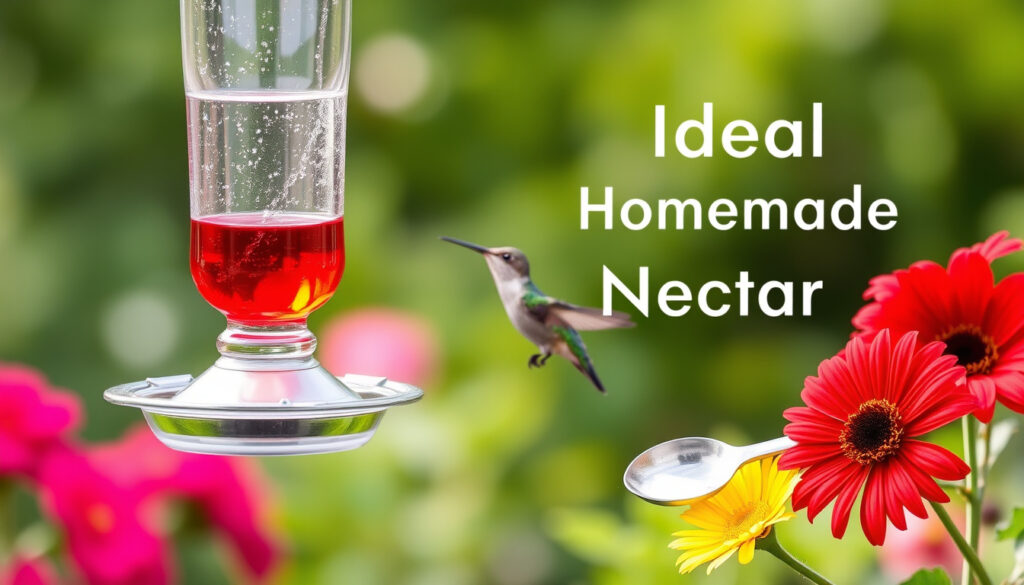
How to Make Hummingbird Food: Best Nectar Recipe Ratio
Anyone who’s watched a ruby-throated hummingbird hover at a feeder knows how magnetic these birds can be. Getting the nectar right matters more than most people realize — wrong ratios or additives can actually harm these tiny visitors. The good news? You only need two ingredients and about ten minutes to make something far better than anything sold in stores.
Standard Ratio: 1 part sugar to 4 parts water · Boil Time: 1–2 minutes until dissolved · Shelf Life: Up to 1 week refrigerated · Key Source: Smithsonian National Zoo
Quick snapshot
- 1:4 ratio standard per Smithsonian National Zoo and Audubon Society
- Red dye is unnecessary and potentially harmful (Smithsonian National Zoo)
- Refrigerated nectar stays fresh up to 1 week (Smithsonian National Zoo)
- Exact winter-ratio variations lack authoritative consensus
- Long-term health impacts of 1:3 vs 1:4 ratios unstudied
- Recipe consensus established across Smithsonian and Audubon for years
- 1:3 ratio debate persists but lacks institutional backing
- Clean feeders twice weekly in summer to prevent mold
- Store extra nectar in the fridge for up to seven days
What is the ratio of sugar to water for hummingbird food?
The standard recommendation is one part refined white sugar to four parts water, producing a 20% sucrose solution. According to the Smithsonian National Zoo (official recipe resource from a Tier 1 government institution), the ratio matches natural floral nectar concentrations without overloading birds with excess sugar. The Audubon Society confirms this 1:4 formulation as the safest, most effective approach for backyard feeders.
Standard 1:4 ratio explained
For everyday feeding, mix one cup of white sugar with four cups of water. This works out to approximately 1/4 cup of sugar per cup of water if you’re making smaller batches. The Smithsonian bird ecologist Brian Evans and nutritionist Erin Kendrick explain in a Smithsonian video that this concentration aligns with what hummingbirds encounter in native flowers, making it the closest artificial match to natural food sources.
Why 4:1 water to sugar
Hummingbirds require enormous amounts of energy relative to their body size. Their metabolism burns through glucose rapidly, but they also need adequate hydration from their food sources. The 1:4 ratio strikes a balance: concentrated enough to provide real caloric value, but watery enough to supplement their hydration needs. The Audubon Society specifically warns against strengthening the mixture beyond this ratio, noting that excess sugar can tax the birds’ kidneys over time.
Is 5:1 ratio safe?
Some enthusiasts experiment with 1:5 dilution (even weaker) for summer heat, but there’s no documented benefit. The 1:4 ratio remains the floor for nutritional adequacy. Going stronger — like the occasional 1:3 suggestion found online — means approaching 25% sucrose concentration, which exceeds what wild flowers typically provide. According to Slim Pickin’s Kitchen citing LSU Museum of Natural Science research, natural floral nectar measures around 23.9% sucrose by comparison, suggesting that even 1:3 sits at the upper edge of what these birds evolved to process.
How can you make hummingbird food?
The process takes less than fifteen minutes and requires only white sugar and water. Avoid honey, corn syrup, organic sugar, brown sugar, or any product containing additives. Per the Smithsonian (primary conservation research institution), these alternatives introduce harmful bacteria, iron, or fungal spores that can devastate hummingbird populations.
Ingredients needed
- Refined white table sugar — no substitutes
- Tap water or filtered water
- Optional: vinegar for cleaning feeders
That’s it. Nothing else belongs in a hummingbird feeder. The Smithsonian explicitly states that powdered sugar contains cornstarch, which can coat birds’ tongues and beaks. Raw sugars may retain trace minerals or iron that accumulates dangerously in hummingbird tissue over time.
Step-by-step recipe
- Measure four cups of water and pour into a clean pot or kettle.
- Bring water to a boil — the Smithsonian notes boiling isn’t strictly required, but it speeds dissolution and kills surface bacteria.
- Add one cup of white sugar while stirring continuously.
- Boil for one to two minutes until the solution turns completely clear.
- Remove from heat and let cool to room temperature — never fill feeders with hot nectar.
- Pour into clean feeder and store excess in the refrigerator.
The Smithsonian clarifies that if you shake or stir vigorously enough, sugar dissolves in cool water without boiling. The heat step simply accelerates the process and adds a margin of safety against contamination.
Easy no-boil method
Combine one cup of sugar with four cups of room-temperature water in a sealed jar. Shake vigorously for 60 seconds. Let rest for five minutes, then shake again. If any sugar crystals remain at the bottom, add a splash more water and repeat. This works perfectly well — the birds won’t notice the difference, and you’ll save energy while achieving identical nutrition.
You don’t need fancy equipment or organic ingredients. One dollar of white sugar and tap water makes a better product than anything in a garden-center bottle — and it takes only minutes.
Why do you have to boil sugar water for hummingbirds?
Boiling serves two purposes: it accelerates sugar dissolution and it neutralizes microbial contamination. Even clean-looking tap water carries surface bacteria that can multiply in warm nectar. A brief boil eliminates this risk, extending the safe storage window and protecting birds from exposure during hot weather when feeders sit in direct sunlight.
Prevents fermentation
Sugar solutions ferment rapidly in warm conditions — the Smithsonian estimates that unrefrigerated nectar can turn cloudy and alcoholic within 24–48 hours during summer. Fermented nectar causes disorientation in hummingbirds, similar to alcohol intoxication in humans. Boiling and refrigeration are the only reliable countermeasures.
Kills bacteria
The Smithsonian video featuring bird ecologist Brian Evans specifically mentions that boiling addresses bacterial contamination from water sources and environmental exposure. Even with clean feeders, airborne bacteria settle into open sugar water. A one-to-two-minute boil eliminates these colonizers completely.
Ensures full dissolution
Undissolved sugar settles at the bottom of feeders, creating super-concentrated pockets that can overwhelm a bird’s kidneys if consumed. Boiling water dissolves sugar instantly; cold water requires extended agitation. For consistency across batches, boiling is the reliable method that guarantees every sip equals the intended 1:4 ratio.
Hummingbirds have no sense of smell and rely entirely on visual cues and sugar detection via their tongues. A contaminated feeder looks identical to a clean one — by the time you notice cloudiness, the damage to bird populations may already be done.
How long do I need to boil sugar water for hummingbirds?
One to two minutes at a rolling boil suffices. According to the Smithsonian (government conservation authority), this timeframe completely dissolves sugar and kills surface bacteria without concentrating the mixture through excessive evaporation. Overboiling risks reducing water volume, effectively raising the sugar concentration beyond the intended 1:4 ratio.
Minimum time
The moment water reaches a rolling boil — visible bubbles breaking the surface continuously — start your timer. One minute ensures sugar fully dissolves and most bacteria die. Two minutes provides a safety margin if you’re using non-potable water or if the batch will sit in warm conditions for extended periods.
Stovetop vs microwave
Stovetop boiling is traditional and reliable, but you can also microwave water in a microwave-safe container for 2–3 minutes until very hot, then stir in sugar until dissolved. Either method produces identical results. The Smithsonian notes that boiling isn’t mandatory — it simply provides convenience and an extra sterility margin.
Cooling process
Never fill feeders with hot nectar. Birds will avoid hot liquid, and thermal expansion can crack plastic reservoirs. Allow nectar to cool to room temperature (roughly 20–25 minutes on the counter) before filling. If you’re in a hurry, place the pot in a sink filled with cold water — this accelerates cooling without shocking the glass.
What is the healthiest thing to feed hummingbirds?
Plain refined white sugar dissolved in water at a 1:4 ratio is the only scientifically validated formula for captive hummingbird feeding. The Smithsonian’s Erin Kendrick (nutritionist) and Brian Evans (bird ecologist) both stress that natural flower nectar — not commercial products or substitutes — provides the benchmark for safety and nutrition.
Plain sugar water
Refined white table sugar contains no iron, no additives, and no competing minerals that could accumulate in hummingbird tissue. The Audubon Society explicitly recommends this ingredient and nothing else. Their official guide warns that even “natural” sugars like cane juice or organic variants may contain trace iron levels harmful to these birds over time.
Avoid commercial mixes
Store-bought hummingbird nectar mixes frequently contain red dye — a practice explicitly condemned by the Smithsonian and Audubon as unnecessary and potentially toxic. While birds are attracted to red feeder ports, the color in the nectar provides no nutritional benefit and may cause kidney damage with repeated exposure. The Audubon Society notes that the red plastic on feeders themselves is sufficient to attract birds; adding dye to the food serves no purpose.
Natural supplements
Rather than altering the nectar formula, plant native flowers around your feeder setup. The Smithsonian’s bird-friendly yard guide recommends Eastern columbine, cardinal flower, and trumpet honeysuckle as natural nectar sources that complement artificial feeding. These plants also attract insects that provide protein supplementation birds can’t get from sugar water alone.
Commercial mixes trade ingredient control for convenience — making your own costs less, takes ten minutes, and eliminates every ingredient that birds don’t need.
Sugar ratios at a glance
Three options dominate the conversation, each with a different constituency of support.
| Ratio | Sucrose % | Best for | Authority |
|---|---|---|---|
| 1:4 (standard) | 20% | Year-round general use | Smithsonian National Zoo, National Audubon Society |
| 1:3 (alternative) | 25% | Cold weather energy boost | LSU Museum of Natural Science (via bloggers) |
| 1:5 (dilute) | ~17% | Extreme summer heat | No institutional backing |
The pattern is clear: the 1:4 standard has decades of institutional validation from government conservation bodies. The 1:3 alternative shows up primarily in community discussions citing university research, but lacks adoption by any authoritative wildlife organization. The 1:5 version has no documented support whatsoever.
What we know vs what we’re still figuring out
Confirmed
- 1:4 ratio matches natural nectar concentration per Smithsonian
- Red dye causes harm — Audubon and Smithsonian both condemn it
- Refrigerated nectar stays viable for one week
- Boiling extends safe storage and kills surface bacteria
- Refined white sugar is the only safe sweetener
- Tap water works fine if sugar fully dissolves
Uncertain
- Optimal winter ratio lacks institutional guidance
- Long-term health impacts of 1:3 ratio unstudied
- Beet sugar acceptability not formally tested
- Regional climate adjustments not standardized
What the experts say
Mix 1 part sugar with 4 parts water (for example, 1 cup of sugar with 4 cups of water) until the sugar is dissolved.
— Smithsonian National Zoo, official feeding guide
Please do not substitute honey, which can promote dangerous fungal growth, or use red food coloring.
— National Audubon Society, nectar preparation guide
Several published studies have found that the sucrose concentration of the nectar in hummingbird flowers is 23.9%.
— Slim Pickin’s Kitchen, citing LSU Museum of Natural Science research
Related reading: Smithsonian hummingbird nectar recipe · Audubon Society hummingbird nectar guide
Frequently asked questions
Why do you put aluminum foil on hummingbird feeders?
Some birders loosely wrap foil around feeder ports to create a reflective surface that confuses ants and bees. The visual disruption discourages crawling insects from approaching the nectar. This is an optional pest-control measure, not a required feeding technique.
What does 4 parts water and 1 part sugar mean?
It means for every one unit of sugar, you add four identical units of water. If you use one cup of sugar, mix in four cups of water. The math works in any measurement: tablespoons, ounces, liters — maintain the 1:4 proportion regardless of the unit you choose.
What is the hummingbird’s worst enemy?
Cats and window collisions are the leading causes of hummingbird mortality in residential settings. Disease and contaminated food rank second. Providing clean nectar in predator-protected feeders reduces the most preventable risks.
Why should you sprinkle coffee grounds around your bird feeder?
Some gardeners report that coffee grounds deter ants, which can contaminate feeders. The caffeine scent may act as a repellent. However, the Smithsonian notes no scientific endorsement of this practice for hummingbird protection specifically — it’s a community observation, not an evidence-based recommendation.
How do you make hummingbird food for winter?
During cold weather, some people switch to a 1:3 ratio (more sugar) to provide extra calories as birds burn energy staying warm. The Smithsonian does not formally endorse this variation, but Audubon observers note increased aggression at feeders during freezes when birds need more fuel. Monitor your feeder and adjust based on bird activity levels.
How do you make hummingbird food without sugar?
You can’t. Hummingbirds survive on sucrose; no artificial sweetener replicates this energy source safely. Some commercial products use glucose or fructose blends, but these lack the metabolic profile that hummingbirds require. Refined white sugar is the only safe option — there is no substitute.
Is a 3 to 1 ratio hummingbird food safe?
The 3:1 ratio (3 parts water to 1 part sugar, or 25% sucrose) approaches the upper natural range and lacks institutional endorsement. The Smithsonian and Audubon both recommend 1:4 as standard. Some wildlife rehabilitators use 1:3 for sick or underweight birds under supervision, but this isn’t a general-use recommendation. Going stronger risks kidney strain over time.
For backyard birders, the choice is straightforward: one part white sugar to four parts water, made fresh or refrigerated for up to a week. This formula has the backing of the Smithsonian National Zoo, the National Audubon Society, and decades of ornithological research. Commercial mixes with red dye remain popular but carry documented risks that aren’t worth the convenience. Clean your feeder twice weekly in summer, weekly in cooler months, and watch for cloudiness that signals it’s time to dump and start over. Hummingbirds will find your feeder — the quality of your nectar determines whether they thrive or suffer.
More related posts
 Can You Get Pregnant When You’re Not Ovulating? Facts
 Same Day Flower Delivery – Fast Reliable Options Near You
 Wine Bar Near Me: Best Ireland Wine Bars & Tips
 System of a Down Tour 2026: Dates, Tickets & UK Shows
 Uber Eats Gift Card Guide: Buy, Gift & Redeem Online
 YouTube TV Pricing 2026: Plans & Costs
 AT&T Settlement: Claims, Eligibility & Payouts
 Top Movies to Stream Right Now on Netflix & Prime
