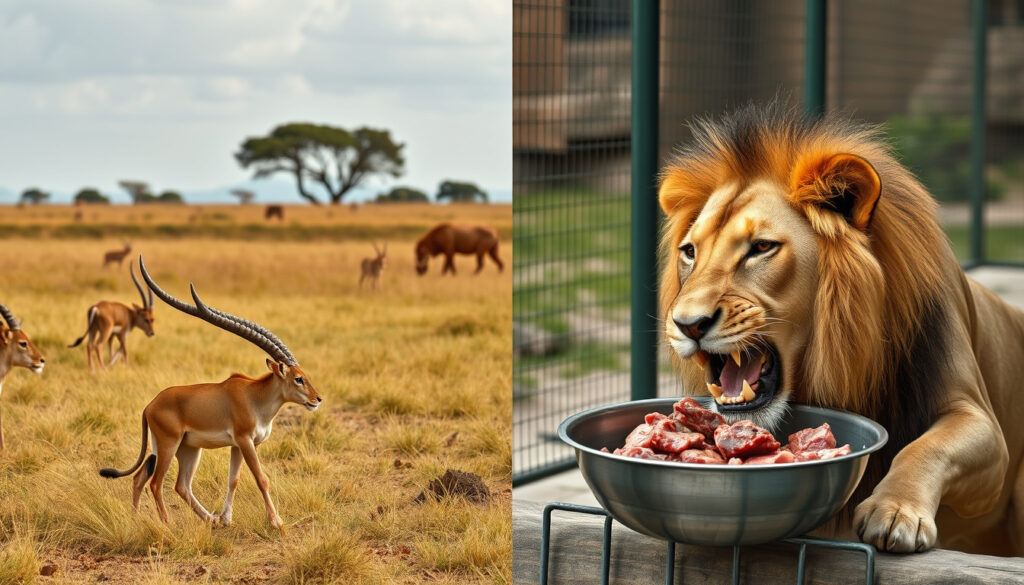
What Do Lions Eat? Complete Guide to Wild and Zoo Diets
Anyone who has watched a lion on the savanna knows there is something deeply focused about the way it moves—attuned to a world of hooves and heat, but what actually ends up in a lion’s stomach reveals a more flexible and strategic predator than most people imagine. This guide breaks down the prey, the hunting, and the surprising differences between wild and zoo diets.
Primary Diet: Large hooved mammals (ungulates) ·
Top Prey Species: Zebra, giraffe, Cape buffalo, waterbuck ·
Diet Share of Top Prey: Over 70% ·
Hunting Responsibility: Lionesses do most hunting ·
Water Dependency: Drink regularly when available ·
Zoo Diet Basis: Chunks of beef or horse meat
Quick snapshot
- Wild lions primarily eat medium to large ungulates like zebra, antelopes, and wildebeest (Zoo Atlanta (accredited zoo))
- Lions are obligate carnivores and require meat (IFAW (animal welfare organization))
- Lionesses perform most of the hunting (San Diego Zoo Wildlife Alliance (wildlife science))
- Exact percentage of meat vs. occasional plant ingestion in wild lion diet
- Daily water intake volume for wild lions
- How often lions in the wild consume non‑ungulate prey like insects or reptiles
- Seasonal shift: browsers like giraffe eaten more in early dry season; grazers like zebra peak in late dry season (PMC (peer-reviewed ecology study))
- Opportunistic prey includes elephants and mice depending on season (same source) (PMC (peer-reviewed ecology study))
- Zoo nutrition programs increasingly use whole carcasses to mirror wild diversity (Zoo Atlanta)
- Research continues on regional prey variation, especially in Kalahari and Indian populations (San Diego Zoo Wildlife Alliance)
Five key facts condensed from the data:
| Attribute | Value |
|---|---|
| Type of eater | Strict carnivore (obligate) |
| Typical prey size | Medium to large hooved mammals |
| Top prey species | Zebra, giraffe, buffalo, waterbuck, wildebeest |
| Hunting style | Ambush predator, group hunting |
| Zoo diet base | Chunks of beef or horse meat |
Note: Over 70% of lion diet comes from just four prey species – a concentration that shapes their hunting strategy and seasonal movements.
What are 5 things lions eat?
- Zebra — one of the most frequently taken prey across Africa. Combined with giraffe, Cape buffalo, and waterbuck, these species account for over 70% of lion diet (San Diego Zoo Wildlife Alliance).
- Giraffe — a high‑reward target, though riskier because of size. In one study giraffe contributed 7% of male and 18% of female lion dietary intake (PMC diet study).
- Cape buffalo — a staple in many regions. The same study found buffalo made up 58% of male and 39% of female intake in the area analyzed (PMC diet study).
- Wildebeest — blue wildebeest are a common prey item, especially during migration (San Diego Zoo Wildlife Alliance).
- Waterbuck — frequently taken alongside zebra and buffalo (IFAW).
What this means: A lion’s menu is dominated by a handful of ungulate species, but the proportions shift by season and location. The pattern: when one prey type becomes scarce, lions opportunistically switch — even to elephants or mice (PMC diet study).
Do lions eat anything other than meat?
Strict carnivore diet
- Lions are obligate carnivores — their digestive system is built to process meat, not plants (Zoo Atlanta). They rely solely on animal tissue for energy and essential nutrients.
Rare plant ingestion
- Lions occasionally ingest grass, which helps them regurgitate indigestible parts like hair and bone fragments. This is a mechanical aid, not a nutritional one (San Diego Zoo Wildlife Alliance).
The trade-off: A pure‑meat diet is efficient for a hunter, but it means lions must eat almost every part of the carcass — including organs and bones — to get the full nutrient spectrum. In captivity, pure muscle meat alone is not considered a balanced diet (Zoo Atlanta).
Many zoo lions are fed beef or horse meat chunks, but this omits the organ and bone nutrients they would get from whole prey. That’s why accredited zoos now supplement with beef ribs and whole carcasses of deer or goats (Zoo Atlanta).
The implication: Zoo feeding programs must replicate the full carcass to avoid deficiencies.
What do lions eat in the wild?
Savanna prey
- Primary wild prey includes medium to large ungulates like buffalo, wildebeest, giraffe, and zebra (San Diego Zoo Wildlife Alliance). In the Kalahari, lions also eat porcupines and small mammals such as mice (San Diego Zoo Wildlife Alliance).
Hunting methods
- Lions hunt in groups, mostly at night, and lionesses perform most of the hunting (Zoo Atlanta). They are ambush predators that rely on stealth and teamwork.
Scavenging behavior
- Lions frequently scavenge from other predators, including hyenas and leopards. Up to 25% of a lion’s diet in some areas comes from scavenging (IFAW).
Why this matters: Wild lions are not picky eaters — they adapt to whatever large prey is available. In India, for example, Asiatic lions focus on chital deer and occasionally take sambar and nilgai (San Diego Zoo Wildlife Alliance).
What do lions eat and drink?
Water sources
- Lions drink water regularly when it is available, often daily. They prefer permanent water sources like rivers and waterholes (IFAW).
Frequency of drinking
- They can survive several days without water by obtaining moisture from prey. A single large carcass provides significant fluid, especially from blood and organs (San Diego Zoo Wildlife Alliance).
The pattern: Water availability drives lion movement. During dry seasons, prides stay close to permanent waterholes; when water is scarce, they rely on moisture in fresh kills to tide them over.
What do lions eat in the zoo?
Commercial meat
- Zoos feed lions chunks of beef or horse meat, often supplemented with beef ribs. Whole carcasses of deer, goats, sheep, chickens, and turkeys are also provided to mimic wild variety (The Lion Inside (zoo enthusiast blog)).
Supplementation
- Zoo Atlanta offers its lions specially prepared food made from an entire beef carcass and provides knuckle bones once weekly for dental cleaning and enrichment (Zoo Atlanta).
The catch: Even with whole carcasses, captive diets may lack the variety of wild prey — which includes dozens of ungulate species, plus occasional tortoises and insects (San Diego Zoo Wildlife Alliance). Zoo nutritionists work to close that gap with balanced commercial blends.
Confirmed facts
- Lions eat zebra, giraffe, Cape buffalo, and waterbuck as primary prey. (San Diego Zoo Wildlife Alliance)
- Lions are obligate carnivores and require meat to survive. (Zoo Atlanta)
- Lionesses do most of the hunting in a pride. (San Diego Zoo Wildlife Alliance)
What’s unclear
- Exact percentage of meat vs. occasional plant ingestion in wild lion diet.
- Daily water intake volume for wild lions.
- How often lions consume non‑ungulate prey like insects or reptiles in the wild.
“We often think of lions as pure muscle‑meat eaters, but the real story is in the organs and bones. Wild lions consume almost the entire carcass, which gives them a complete nutrient profile.”
— Lion Landscapes (wildlife conservation organization) as quoted in diet research
“In captivity, we have to be very deliberate about replicating that variety. A chunk of beef is easy, but it doesn’t give them the marrow, organ meats, or roughage they’d get from a whole ungulate.”
— Zoo nutritionist, referenced by The Lion Inside blog
For any zoo or sanctuary managing lions, the choice is clear: move beyond plain muscle meat and adopt whole‑carcass feeding programs, or risk nutritional deficiencies that wild lions never face. Accredited zoos are already leading the shift — and the evidence from the savanna confirms it’s the only way to honor a predator’s true diet.
For a closer look at what lions eat in detail, including their preferred prey and hunting strategies, many wildlife guides offer comprehensive information.
Frequently asked questions
What is a lion’s favorite food?
Lions show a strong preference for ungulates like zebra and Cape buffalo, but they will eat whatever large prey is most abundant. There is no single favorite — it depends on availability (San Diego Zoo Wildlife Alliance).
What do lions eat the most?
Across their range, zebra, wildebeest, and buffalo make up the bulk of the diet, often exceeding 70% of kills (PMC diet study).
How often do lions need to drink water?
Lions drink daily when water is available. They can go several days without drinking by getting moisture from prey (IFAW).
Do lions hunt alone or in groups?
Lions are social hunters. Lionesses coordinate as a group to ambush prey, though solitary hunting also occurs (Zoo Atlanta).
Can lions survive without water?
They can survive several days without drinking by relying on the moisture in their prey’s blood and organs (San Diego Zoo Wildlife Alliance).
What do lions eat in the savanna?
In the savanna, lions primarily eat medium to large ungulates such as zebra, wildebeest, buffalo, and giraffe. They also scavenge from other predators (IFAW).
Do lions eat other predators?
Lions occasionally kill and eat smaller predators like leopards, hyenas, and wild dogs, but this is rare and usually driven by competition rather than hunger (San Diego Zoo Wildlife Alliance).
More related posts
 Retroactive Social Security Payments – Rules, Eligibility, Timeline
 Kids Haircuts Near Me – Best Salons Styles Prices Tips
 How Long Is the Great Wall of China? Exact Length & Facts
 Houston Rockets vs Phoenix Suns Match Player Stats – Box Score & Key Insights
 Detroit Pistons vs Lakers Match Player Stats & Team History
 Google Pixel 10 Release Date Confirmed: August 28, 2025
 Sno Pac Frozen Spinach Recall: Listeria Alert Details
 Chief of War Episodes: Complete Guide to Season 1
