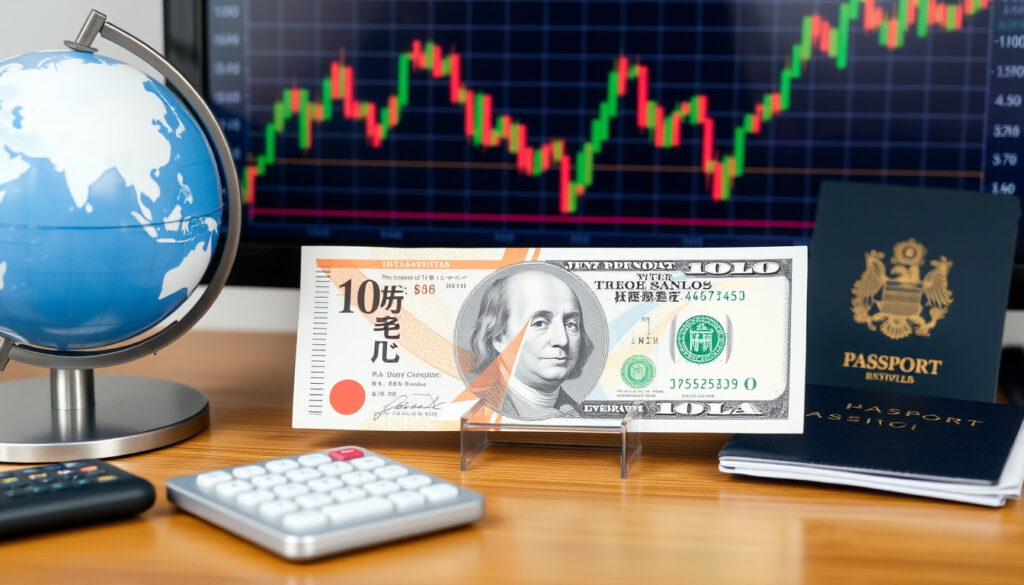
Yen to USD Exchange Rate: Current Rates & Travel Tips
Anyone who has ever tried to convert yen to dollars knows the gap between the rate you see online and the rate you actually get at a counter. Right now, 1 US dollar buys about 160 Japanese yen at the mid-market rate, according to Wise (online money transfer platform). This guide breaks down what those numbers mean for travelers, shoppers, and anyone sending money between Japan and the US — and how to avoid losing value in the spread.
1 JPY to USD: 0.0062 USD (mid-market rate) ·
1 USD to JPY: 160.2 JPY (mid-market rate) ·
$100 USD in yen: 16,020 JPY (approx.) ·
1000 JPY in USD: 6.20 USD (approx.) ·
Date of rates: Current as of June 12, 2026
Quick snapshot
- 1 USD = 160.2 JPY (Xe (currency data provider))
- 1 JPY = 0.0062 USD (Wise (online money transfer platform))
- 2025 annual average: 149.57 JPY per USD (Federal Reserve (U.S. central bank))
- Future direction of USD/JPY — rates fluctuate continuously (Flywire (international payments provider))
- Exact retail markups at every exchange counter vary by location and provider (Flywire (international payments provider))
- USD/JPY at 160.2400 on June 12, 2026 (Bloomberg Markets (financial news))
- Federal Reserve 2025 annual average: 149.57, showing yen weakening against dollar (Bloomberg Markets (financial news))
- Compare rates from multiple sources before converting (Flywire (international payments provider))
- Consider specialized transfer services for rates closer to mid-market (Wise (online money transfer platform))
| Metric | Value |
|---|---|
| Current mid-market rate | 1 JPY = 0.0062 USD (as of June 12, 2026) |
| Inverse rate | 1 USD = 160.2 JPY |
| Source | Xe (currency data provider) / Wise (online money transfer platform) |
| Date verified | June 12, 2026 |
The table above shows the benchmark figures — but retail consumers rarely get these exact numbers.
How much is $1 US in yen today?
At the mid-market rate tracked by financial platforms, one US dollar buys about 160 Japanese yen. This means 1 USD = 160.2 JPY, as reported by Xe (currency data provider). The same rate is confirmed by Wise (online money transfer platform), which shows a live rate of 1 JPY = 0.00623666 USD. These are the wholesale rates that banks use between each other — not what you’ll see at an airport counter.
How much is $100 US in yen?
Multiply the $100 by the current rate. At 160.2, $100 equals roughly 16,020 JPY. The Federal Reserve (U.S. central bank) recorded a 2025 annual average of 149.57, so the actual amount has shifted upward as the yen weakens.
How much is 1 million yen to US dollars?
One million Japanese yen converts to about 6,200 US dollars at the mid-market rate (1,000,000 × 0.0062). According to MTFX (currency exchange services), the latest rate is 1 JPY = 0.0062 USD.
How much is 1 billion yen to US dollars?
One billion yen is about 6.2 million dollars. At 1 JPY = 0.0062 USD, 1,000,000,000 × 0.0062 = 6,200,000 USD. For large transfers, services like OFX (foreign exchange provider) offer rates that typically beat retail banks.
The mid-market rate is a benchmark, not a price. Every bank, ATM, and credit card adds a spread. For a $100 conversion, that spread can cost you $3-5 — easily 15% of the value if the spread is wide.
How much is 1000 yen worth in US money?
One thousand yen converts to about 6.20 US dollars at the current mid-market rate. That’s enough for a convenience store meal in Tokyo but less than a single coffee in New York.
How much is 100 yen to US dollars?
100 Japanese yen is worth about 0.62 USD. This is the pocket-change equivalent — a vending machine drink in Japan costs roughly that.
How much is 10,000 yen to US dollars?
10,000 JPY equals approximately 62 USD. This is a typical amount for a day’s budget for a mid-range traveler, covering meals, local transport, and entry fees. Data from Wise (online money transfer platform) confirms 10,000 JPY = 62.00 USD at the mid-market rate.
How much is 5,000 yen to US dollars?
5,000 yen translates to roughly 31 USD. At current rates, that’s about the cost of a decent sushi dinner in a Tokyo neighborhood restaurant.
Is $50,000 yen enough for a week in Japan?
50,000 yen is about 310 US dollars. Whether that covers a week depends entirely on your style. A budget traveler spending 10,000-15,000 JPY per day could stretch it to 3-5 days.
Is 100,000 yen a lot of money?
100,000 yen (roughly 620 USD) is a substantial amount in Japan. It can cover a week of comfortable travel including accommodation in a business hotel and three meals out. According to Flywire (international payments provider), exchange rates are in constant flux, so the buying power changes daily.
What is the average daily cost in Japan?
A budget traveler can expect to spend about 10,000-15,000 JPY per day on food, transport, and attractions. Mid-range travel runs 20,000-30,000 JPY per day. Using the current rate, that’s 62-186 USD per day — less than a comparable trip in Western Europe.
A traveler carrying $2,000 in spending money will receive roughly 320,000 JPY at the mid-market rate. But if they exchange at a currency counter charging 3%, they lose about $60 — a night’s lodging in a budget hotel.
Is USD stronger than yen?
Yes, the US dollar is significantly stronger than the Japanese yen. One dollar buys more than 160 yen, meaning the dollar’s purchasing power is about 160 times greater per unit. The Federal Reserve (U.S. central bank) reports that the 2025 annual average was 149.57 yen per dollar, showing the yen has weakened further against the dollar in recent years.
The yen’s decline is driven by Japan’s ultra-loose monetary policy and interest rate differentials with the US. As of Bloomberg Markets (financial news), the pair traded at 160.2400 on June 12, 2026 — about 7% weaker than the 2025 average.
How far does $20 go in Japan?
Twenty US dollars converts to about 3,200 Japanese yen at the mid-market rate. That’s enough for a hearty bowl of ramen (1,000-1,500 JPY) plus a convenience store meal (500-800 JPY) and still have change for a train ticket.
What can you buy with 3,000 yen?
3,000 yen (roughly $18.60) can buy a filling lunch set, a coffee, and a snack from a convenience store. It’s also the price of a museum entry or a short taxi ride in central Tokyo.
How expensive is Japan for tourists?
Japan is surprisingly affordable for visitors from strong-currency countries. A meal at a chain restaurant costs 700-1,200 JPY ($4.30-$7.40). Public transport is efficient and moderately priced. With $20, you can eat well for a day if you choose carefully.
| Conversion | Mid-market rate | Typical retail rate (bank/ATM) | Difference (loss) |
|---|---|---|---|
| $100 → JPY | 16,020 JPY | 15,700 JPY | ~320 JPY ($2) |
| $1,000 → JPY | 160,200 JPY | 157,000 JPY | ~3,200 JPY ($20) |
| 100,000 JPY → USD | $620 | $605 | $15 |
The pattern is clear: the spread between mid-market and retail rates is small per transaction but compounds on larger amounts. Trade-off: convenience vs. value.
Pros and cons of converting yen to dollars
Upsides
- Mid-market rates from Wise and Xe are free to check and transparent
- Credit cards like Mastercard offer competitive rates (check Mastercard (payment network))
- ATMs in Japan dispense yen at near-mid-market rates for a small fee
Downsides
- Airport exchange counters charge 3-5% spreads
- Bank retail rates are often worse than specialized services (Bank of America (U.S. bank))
- Dynamic currency conversion at terminals adds hidden fees
Steps to convert yen to dollars (or dollars to yen) with minimal loss
- Check the live mid-market rate on Xe (currency data provider) or Wise (online money transfer platform). Write it down.
- Compare with your bank’s rate by calling or checking online.
- Use an ATM in Japan for cash withdrawals — they typically give better rates than currency exchange counters. Check with your bank for foreign ATM fees.
- Consider a specialist transfer like Wise, OFX, or Flywire for amounts over $500. Their Flywire (international payments provider) notes that locally licensed partners often offer rates lower than banks.
- Use a credit card without foreign transaction fees for larger purchases. Mastercard (payment network) provides a currency converter so you can estimate what you’ll be charged.
- Avoid dynamic currency conversion at terminals — always choose to be charged in the local currency (JPY in Japan, USD in the US).
What’s confirmed and what’s unclear
Confirmed facts
- Current mid-market rate: 1 USD = 160.2 JPY (Xe (currency data provider), Wise (online money transfer platform))
- Rates fluctuate continuously and are influenced by monetary policy (Flywire (international payments provider))
- Retail rates almost always include a spread or fee
What’s unclear
- Future movement of USD/JPY — no reliable short-term forecasts
- Exact markups at every retail exchange point
- Whether the yen will strengthen or weaken further
Perspectives on the yen-dollar exchange
The mid-market rate for JPY to USD is about 0.00623666 USD per 1 JPY, as shown on our live converter.
Xe (currency data provider)
Our USD to JPY converter uses the real-time mid-market exchange rate. The current rate shows 1 USD = 159.2 JPY.
Wise (online money transfer platform)
Exchange rates are set and quoted by foreign exchange markets and fluctuate regularly due to changing demand and round-the-clock trading.
Flywire (international payments provider)
Understanding the margin between the mid-market rate and what you actually pay is the single most valuable takeaway for anyone converting yen to dollars. For the US traveler heading to Japan, the weak yen means more buying power — but only if you use the right tools and avoid hidden charges.
For the US traveler, the choice is clear: check the mid-market rate on Wise or Xe before every conversion, use a fee-free card, and withdraw cash from ATMs in Japan. For the Japanese business or student sending money to the US, the implication is equally clear: avoid bank wire transfers and use a specialist service like Wise or OFX. The difference can be hundreds of dollars on a large transfer.
Related reading: **Canada Dollar to USD: Live Rate and Living Costs** · **Best Airline Credit Card 2026: Top Picks and Expert Tips**
Frequently asked questions
How often do yen to dollar exchange rates update?
Mid-market rates update continuously during forex trading hours. Most converters refresh every few seconds.
What is the best website for real-time yen to USD conversion?
Xe (currency data provider) and Wise (online money transfer platform) both provide live mid-market rates with timestamps.
Should I exchange currency in Japan or before I go?
Generally, ATMs in Japan offer better rates than airport counters or your home bank. Use a fee-free debit card to withdraw yen upon arrival.
Are there fees when converting JPY to USD online?
Specialist services like Wise and OFX charge a small percentage fee but still often beat bank rates. Always check the total cost including the spread.
How has the yen performed against the dollar over the past year?
The yen weakened from a 2025 average of 149.57 per dollar to around 160 per dollar by mid-2026, according to Federal Reserve (U.S. central bank) and Bloomberg Markets (financial news).
What factors affect the yen to USD exchange rate?
Interest rate differentials, central bank policies, trade balances, and geopolitical events all influence the rate. The Bank of Japan’s ultra-loose policy is a key driver of yen weakness.
Can I use my credit card in Japan to avoid conversion fees?
Yes, many credit cards (especially those with no foreign transaction fees) offer rates close to mid-market. Check your card’s terms and always pay in yen.
Is it cheaper to withdraw cash from ATMs in Japan?
Yes, ATMs in Japan (especially at 7-Eleven and Japan Post) offer competitive exchange rates. Be aware of your home bank’s ATM fees and consider a fee-free travel card.
More related posts
 Ole Miss vs Tulane: Prediction, Odds, History & Score
 Ivermectin Dosage Chart for Humans: By Weight Guide
 Lunar Eclipse September 7, 2025: Time & Visibility in Ireland
 Can Dogs Eat Blueberries? Safety, Benefits, and Feeding Guide
 Type 1 Diabetes Barbie Doll: Where to Buy, Price, Features
 How to Check Mastercard Gift Card Balance – Step-by-Step Guide
 Ri e of the Ronin v Gho t of T u hima & AC Shadow
