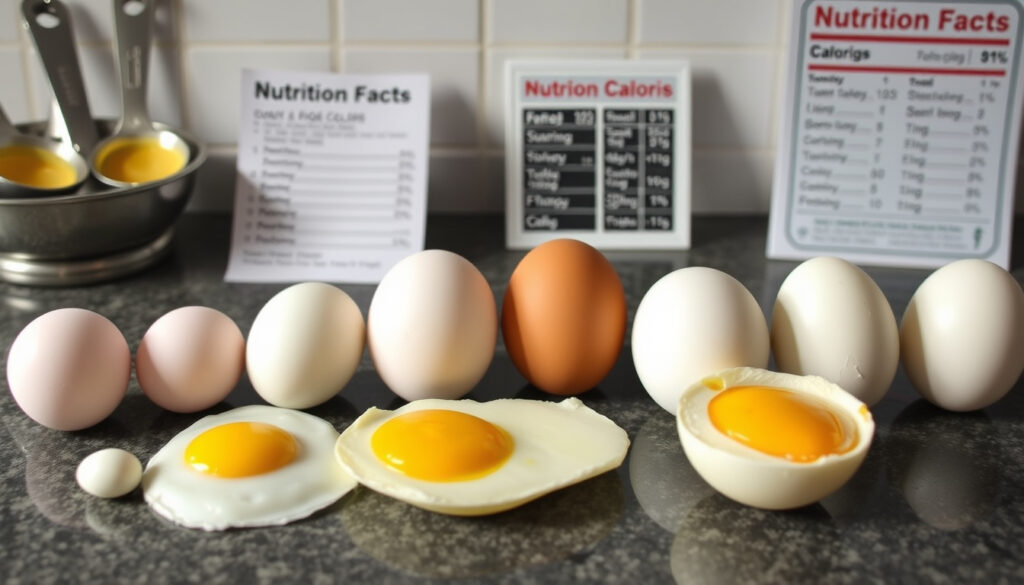
Calories in an Egg: Full Guide by Size and Cooking Method
You’ve probably stared at an egg carton wondering how many calories are inside that oval shell. The answer changes depending on size, cooking method, and whether you eat the yolk. Let’s break down the numbers so you can make informed choices for weight management or blood sugar control.
Large egg (50 g): 70–80 calories ·
Medium egg (44 g): 66 calories ·
Small egg (38 g): 55 calories ·
Egg white (large): 18 calories ·
Egg yolk (large): 55 calories
Quick snapshot
- Small (38 g): ~55 cal (Healthline (nutrition publisher))
- Medium (44 g): ~66 cal (USDA FoodData Central (U.S. Department of Agriculture))
- Large (50 g): ~70–80 cal (USDA FoodData Central)
- Extra large (56 g): ~80–90 cal (Eggs.ca (Canadian egg farmers))
- Boiled/poached: same as raw (Harvard T.H. Chan School of Public Health)
- Fried (in oil/butter): +50–100 cal (Healthline (nutrition publisher)) (Harvard T.H. Chan School of Public Health)
- Scrambled (with milk/butter): +30–60 cal (USDA FoodData Central (U.S. Department of Agriculture)) (Harvard T.H. Chan School of Public Health)
- White (large): 18 cal, 4 g protein (USDA FoodData Central)
- Yolk (large): 55 cal, 5 g fat (USDA FoodData Central)
- All fat and cholesterol in yolk (USDA Food and Nutrition Information Center)
- Does not raise heart disease risk for most people (American Heart Association)
- May aid weight loss when replacing higher-calorie foods (CDC (Centers for Disease Control and Prevention))
- Can help stabilize blood sugar in diabetics (Diabetes Care / ADA Standards of Care)
Six nutrient values give you the full picture of what a large egg contains.
| Nutrient | Value per large egg (50 g) |
|---|---|
| Calories | 70–80 |
| Protein | 6 g |
| Total fat | 5 g |
| Saturated fat | 1.6 g |
| Cholesterol | 186 mg |
| Sodium | 62 mg |
For more on sodium intake, see our guide: How Much Sodium Per Day? Recommended Intake & Guidelines.
How many calories are in one egg?
The answer depends on the egg’s size and how you cook it. According to the USDA FoodData Central (U.S. Department of Agriculture), a large whole egg (50 g) contains about 72 calories. A medium egg (44 g) comes in around 66 calories, and a small egg (38 g) roughly 55 calories, per Healthline (nutrition publisher).
Calories by egg size
- Small (38 g): ~55 calories
- Medium (44 g): ~66 calories
- Large (50 g): 70–80 calories
- Extra large (56 g): 80–90 calories
Size variation matters more than most people think. A difference of one size class can shift your breakfast by 15–20 calories.
Calories in boiled, fried, and scrambled eggs
Boiling or poaching adds zero fat, so the calorie count stays the same as raw. A large hard-boiled egg provides about 78 calories, per Healthline. Frying in oil or butter adds 50–100 calories depending on how much fat is absorbed. Scrambling with milk and butter adds 30–60 extra calories, based on USDA FoodData Central (U.S. Department of Agriculture) data.
The calorie difference between boiled and fried is almost entirely in the cooking fat—not the egg itself. If you’re counting calories, boiling or poaching gives you the most control.
Egg white vs. yolk calories
A large egg white contains roughly 17–18 calories and almost no fat, according to the USDA FoodData Central (U.S. Department of Agriculture). The yolk packs about 55 calories with 5 g of fat and all 186 mg of cholesterol. The USDA Food and Nutrition Information Center notes that yolks also contain most of the egg’s micronutrients, including vitamin D and choline.
Choosing egg whites vs. whole eggs is a trade‑off between calories and nutrition. Whole eggs give you more vitamins and healthy fats; whites give you lean protein at a third of the calories.
How many calories are in 2 full eggs?
Two large eggs deliver about 140–160 calories total. Two medium eggs amount to roughly 132 calories. Boiled eggs keep the same base count because no fat is added—raw eggs and boiled eggs have identical calories, as confirmed by Harvard T.H. Chan School of Public Health.
Two scrambled eggs made with a splash of milk and a pat of butter can climb to 220–280 calories. The extra energy comes entirely from added ingredients, not the eggs themselves.
Is 2 eggs a day too much fat?
A large egg contains about 5 g of total fat, of which 1.6 g is saturated. That’s about 8% of the daily saturated fat limit (Dietary Guidelines for Americans (U.S. Department of Agriculture)). The yolk also holds 186 mg of cholesterol, but the 2020–2025 Dietary Guidelines for Americans no longer list dietary cholesterol as a nutrient of concern for overconsumption. Saturated fat intake is the bigger focus.
Fat and cholesterol content in eggs
- Total fat: 5 g per large egg
- Saturated fat: 1.6 g
- Cholesterol: 186 mg
The American Heart Association says one whole egg or two egg whites can be part of a heart‑healthy eating pattern.
Eggs in a low-saturated-fat diet
If you’re limiting saturated fat to under 10% of daily calories, two eggs supply about 16% of that limit. That’s manageable if the rest of your meals are low in saturated fat. A 2018 meta-analysis published in BMJ (PubMed) found no significant association between egg intake and coronary heart disease or stroke in the general population.
Eggs and weight loss: what the research says
Eggs can support weight loss when they replace higher‑calorie breakfast foods. The CDC (Centers for Disease Control and Prevention) emphasizes that total daily calorie intake is the key driver of weight loss. A randomized trial published in the International Journal of Obesity (PubMed) found that an egg breakfast improved weight‑loss outcomes compared with a bagel breakfast in a calorie‑restricted diet.
For more on medications that aid weight loss, see How Does Semaglutide Work?.
Do eggs help A1C?
Eggs have a minimal direct effect on blood sugar because they contain nearly zero carbohydrates. But their high protein content can blunt post‑meal glycemic spikes, making them a smart choice for people managing diabetes. The American Diabetes Association’s Standards of Care (Diabetes Care) emphasize individualized nutrition therapy rather than a universal carbohydrate or cholesterol rule.
Protein and glycemic response
A large egg provides 6 g of high‑quality protein, which slows digestion and stabilizes blood sugar after meals. Pairing eggs with non‑starchy vegetables (like spinach or bell peppers) creates a balanced plate that supports glycemic control.
Studies on eggs and A1C levels
Some research suggests that regular egg consumption can improve fasting glucose and A1C in people with type 2 diabetes when part of a low‑carb diet. A 2022 review in Nutrients (PubMed) noted benefits but called for more long‑term studies. The evidence is promising but not definitive.
Egg-based breakfast ideas for diabetes
- Scrambled eggs with mushrooms and tomatoes
- Hard‑boiled eggs with a side of avocado
- Vegetable frittata made with egg whites
The takeaway: eggs can be a blood‑sugar‑friendly food when prepared without added fats and paired with vegetables.
What is the 5 5 5 rule for eggs?
The 5‑5‑5 rule is a method for achieving easy‑to‑peel hard‑boiled eggs every time. Here are the steps:
- Boil for 5 minutes: Place eggs in a pot of boiling water (gently lower them with a spoon).
- Rest for 5 minutes: Remove the pot from the heat, cover it, and let the eggs sit in the hot water for 5 minutes.
- Ice bath for 5 minutes: Transfer the eggs to a bowl of ice water and leave them for 5 minutes before peeling.
This timing produces yolks that are fully cooked but not overcooked, and the shells slip off with almost no sticking. The Healthline (nutrition publisher) calls it a reliable technique for consistent results.
Upsides
- Eggs are nutrient‑dense: 6 g protein for ~70 calories.
- Two eggs per day is safe for most people and may support weight loss when part of a calorie‑controlled diet.
- Egg consumption is not linked to heart disease in the general population.
- Eggs have a low glycemic impact, helpful for blood sugar control.
Downsides
- Yolks contain 1.6 g saturated fat per egg; two eggs provide 16% of the daily limit.
- Frying or scrambling adds significant calories and fat.
- Some cohort studies link high egg intake to increased diabetes risk in specific populations (findings are inconsistent).
- People with familial hypercholesterolemia or heart disease may need to limit yolks—consult a doctor.
What we know — and what’s still unclear
- Calorie counts by size are well‑established (USDA FoodData Central)
- Egg whites contain negligible fat and cholesterol (USDA FoodData Central)
- Moderate egg consumption (up to 2 per day) is not linked to increased heart disease risk in healthy individuals (American Heart Association)
- Exactly how many calories are absorbed when frying depends on oil absorption (Healthline)
- Long‑term impact of daily egg consumption on A1C in type 2 diabetes needs more research (Nutrients review (PubMed))
- Some cohort studies link high egg intake to increased diabetes risk in specific populations, but findings are inconsistent (Nutrients review (PubMed))
What experts say
A single medium-sized egg will contain around 66 calories, an average small egg around 55 calories and an average large egg around 80 calories.
Egg whites are high in protein (3.6 grams per large egg white) but very low in calories (18 calories), fat, and cholesterol.
There are 80 calories in a large egg.
The calories in an egg are only part of the story. For someone managing weight or blood sugar, the real opportunity is in how you use them—boiled instead of fried, whole instead of processed meats, paired with vegetables instead of toast. The choice is clear: skip the added fats, keep the yolk for its nutrients, and treat the egg as a building block, not a calorie bomb.
Frequently asked questions
How many calories are in a poached egg?
A large poached egg contains about 72–78 calories—the same as a raw egg, since no fat is added.
Are eggs high in protein?
A large egg provides about 6 g of high‑quality protein, with 3.6 g in the white and 2.7 g in the yolk.
Can eggs help with weight loss?
Yes, when they replace higher‑calorie foods. A calorie‑restricted diet that includes eggs for breakfast has been shown to improve weight‑loss outcomes compared with a bagel breakfast.
Do eggs raise cholesterol?
For most people, dietary cholesterol from eggs has a minimal effect on blood cholesterol. The 2020–2025 Dietary Guidelines no longer set a limit on dietary cholesterol.
How many eggs can I eat per day?
Up to 2 whole eggs per day is considered safe for healthy individuals, according to the American Heart Association.
Are brown eggs healthier than white eggs?
No. Shell color reflects the hen’s breed, not nutritional value. Brown and white eggs have identical nutrient profiles.
What is the best way to cook eggs for weight loss?
Boiling, poaching, or baking without added fat preserves the lowest calorie count. Avoid scrambling with butter or frying in oil.
More related posts
 Jurassic Park 2 Cast: Full List of Actors and Characters
 SNAP Benefits Update Today: Key 2026 Changes & State News
 Sexyy Red Net Worth 2025: From Viral to $1 Million
 How Does Semaglutide Work? GLP-1 Mechanism, Timeline & Tips
 Best Seafood Restaurant Near Me in Ireland: Top Picks
 Places to Rent Near Me – Top Sites, Tips and Local Listings
 Retroactive Social Security Payments – Rules, Eligibility, Timeline
 Smokey and the Bandit Cast: Full List, Ages, Quotes, and More
