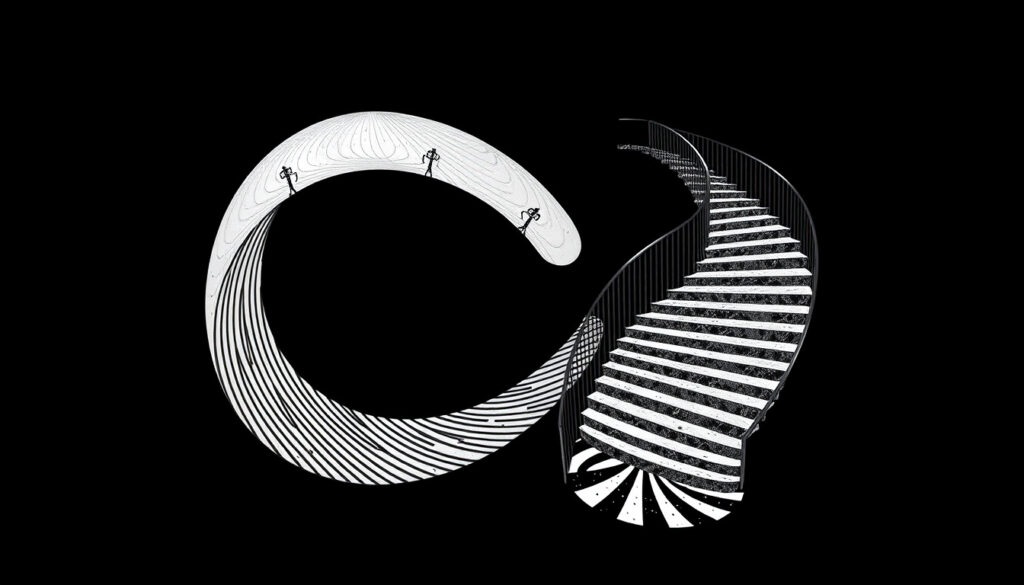
What Is a Paradox? Definition, Famous Examples, and Types
Few conversation starters get people as tangled as a good paradox. They seem to break the rules of logic—yet they keep showing up in philosophy, math, science, and everyday speech.
Definition: A logically self-contradictory statement or one that runs contrary to expectation ·
Origin: Greek ‘paradoxon’ meaning contrary to opinion ·
Known since: Ancient Greek philosophy (ca. 400 BCE) ·
Most cited: Liar paradox
Quick snapshot
- Paradoxes are used in logic to expose contradictions (Internet Encyclopedia of Philosophy)
- The Liar paradox is a classic self-referential paradox (UMBC Undergraduate Catalog)
- Many paradoxes can be resolved by refining assumptions or definitions (Internet Encyclopedia of Philosophy)
- Whether a paradox always indicates a flaw in the premises or a genuine contradiction in reality (Internet Encyclopedia of Philosophy)
- The exact resolution of the grandfather paradox under different models of time travel (Britannica)
- Whether the Liar paradox can be fully resolved within classical logic (Internet Encyclopedia of Philosophy)
- 4th century BCE – Eubulides formulates the Liar paradox (Britannica)
- 1901 – Bertrand Russell discovers Russell’s paradox, shaking set theory (Stanford Encyclopedia of Philosophy)
- 1931 – Gödel’s incompleteness theorems use self-referential paradoxes to show limits of formal systems (Stanford Encyclopedia of Philosophy)
- Paradoxes continue to drive research in AI, logic, and quantum mechanics (Scientific American)
- Educational researchers use paradoxes to teach critical thinking in classrooms (University of Washington Teaching & Learning Showcase)
Six key facts capture the essential shape of a paradox and its history.
| Fact | Details |
|---|---|
| Also Known As | Logical contradiction, antinomy |
| Common Types | Self-referential, veridical, falsidical |
| Related Concepts | Oxymoron, irony, catch-22 |
| First Recorded | 4th century BCE (Eubulides) |
| Formal Definition (Notre Dame) | An apparently acceptable set of premises or reasoning that leads to an unacceptable or contradictory conclusion (University of Notre Dame philosophy handout) |
| IEP Definition | A puzzling conclusion that reasoning seems to force, even though it is highly counterintuitive (Internet Encyclopedia of Philosophy) |
| Pedagogical Use | Exposes students to reasoning that conflicts with intuition and requires explanation (University of Washington Teaching & Learning Showcase) |
What is a paradox with an example?
Simple definition of paradox
- A paradox is a statement that appears self-contradictory on the surface but may contain a deeper truth (Brigham Young University Silva Rhetoricae).
- A more formal definition: a set of individually plausible statements that together are inconsistent (University of Barcelona repository).
In everyday terms, a paradox is a puzzle that seems to break logic, yet it often holds a grain of truth. For example, “less is more” sounds contradictory—how can less be more?—but it captures a real insight about simplicity being powerful. This rhetorical paradox is used in literature and advertising to make us pause and think.
Example: the bootstrap paradox
The bootstrap paradox (a time-travel paradox) goes like this: A time traveler hands Shakespeare a manuscript, which Shakespeare publishes as his own. Decades later, the time traveler finds that manuscript and uses it as the basis for his own writing—creating a loop with no clear origin. It’s a classic self-referential paradox explored in pop culture (movies like Back to the Future and Doctor Who).
The bootstrap paradox shows that time travel narratives often create causal loops—events that cause themselves—which conflict with our linear sense of cause and effect.
The implication: Paradoxes of time travel force physicists and philosophers to reconsider whether time is truly linear or something more tangled.
What is a paradox in simple words?
Everyday language explanation
A paradox is like a riddle where two true-sounding ideas seem to clash. Imagine someone saying “I always lie.” If they always lie, then that statement itself must be a lie—meaning they sometimes tell the truth, which contradicts the original claim. That’s the Liar paradox in action.
Another everyday example: “You have to spend money to save money.” On its face it’s contradictory, but it points to a practical truth—buying in bulk or investing in energy-efficient appliances can reduce long-term costs. Such paradoxes are common in finance, health advice, and even parenting.
Why paradoxes are not just errors
- Paradoxes expose hidden assumptions in our reasoning (University of Washington Teaching & Learning Showcase).
- They are used in humor (think one-liners that invert expectations), literature (thematic contradictions that add depth), and philosophy (to test the boundaries of logic).
So a paradox isn’t a mistake; it’s a clue that you need to look deeper.
When you encounter a paradox, instead of dismissing it, ask: “What assumption am I making that leads to this contradiction?” That shift turns a riddle into a lesson.
The trade-off: The more we analyze paradoxes, the more we realize that our simplest mental models often fail to capture the complexity of the real world.
What is the most famous paradox?
The Liar paradox
- The Liar paradox is the statement “This statement is false.” If the statement is true, then it must be false; if it is false, then it must be true. It is a classic self-referential paradox (UMBC Undergraduate Catalog).
- It is attributed to Eubulides of Miletus, a Greek philosopher from the 4th century BCE (Britannica).
Why it matters in logic
The Liar paradox exposed a serious problem in formal logic: any system that can talk about its own truth values risks inconsistency. This insight directly influenced the development of modern logic, including Gödel’s incompleteness theorems (Stanford Encyclopedia of Philosophy).
Philosophers have proposed various resolutions—banning self-reference, introducing truth hierarchies, or adopting paraconsistent logic (Internet Encyclopedia of Philosophy). None is universally accepted, which is why the Liar paradox remains a central puzzle.
What this means: The Liar paradox didn’t just puzzle ancient Greeks—it reshaped how we think about truth, language, and the limits of formal systems.
How to explain paradox to a kid?
Kid-friendly definition
A paradox is a riddle that seems impossible but can still be true. For example, “the birthday paradox” says that in a group of just 23 people, there’s a 50% chance two share a birthday. That feels surprising because 23 seems small, but the math works out (University of Pittsburgh teaching page).
Examples: the birthday paradox and the ant on a rope
- Birthday paradox: In a classroom of 23 kids, odds are 50-50 that two have the same birthday. Kids find this hard to believe until they test it.
- Ant on a rope: Imagine an ant crawling along a rope that is being stretched uniformly. The ant’s progress seems impossible to reach the end, but mathematically it can (under certain conditions) catch up.
You can also use everyday contradictions: “You have to spend money to save money” or “the more you give, the more you get.” These are paradoxes in action.
For parents and teachers, paradoxes are gold: they build critical thinking by forcing kids to look past the obvious explanation.
The pattern: Kids who learn to spot paradoxes early become more comfortable with ambiguity—a skill that serves them in math, science, and life.
What are 5 examples of paradox?
1. The liar paradox
“This statement is false.” As discussed, it’s the classic self-referential paradox (UMBC Undergraduate Catalog).
2. The grandfather paradox
A time traveler goes back and kills their grandfather before the traveler’s parent is born—preventing the traveler’s own existence. This creates a logical contradiction: if the traveler never exists, who killed the grandfather? (Britannica)
3. The ship of Theseus
If every part of a ship is replaced over time, is it still the same ship? This thought experiment pushes at the boundaries of identity and change. It has been discussed since ancient Greek philosophy.
4. The crocodile’s dilemma
A crocodile steals a baby and promises to return it if the parent correctly predicts what the crocodile will do next. If the parent says “you will not return my baby,” the crocodile faces a paradox: if it returns the baby, the prediction is false, but if it does not, the prediction is true—either way it must violate its promise. This illustrates a logical trap similar to the Liar paradox.
5. The unexpected hanging paradox
A prisoner is told he will be hanged on a surprise day next week. He deduces that he cannot be hanged on Friday (because by Thursday night it would no longer be a surprise), then eliminates Thursday, Wednesday, etc., concluding he cannot be hanged at all. Yet when Tuesday morning arrives, the hanging happens—and it is a surprise. This paradox highlights the difficulty of reasoning about knowledge and surprise.
The catch: These five paradoxes each expose a different kind of flaw in our reasoning—self-reference, causation, identity, prediction, and knowledge—showing that paradoxes are not all the same.
Confirmed facts
- Paradoxes are used in logic to expose contradictions.
- The Liar paradox is a classic self-referential paradox.
- Many paradoxes can be resolved by refining assumptions or definitions.
What’s unclear
- Whether a paradox always indicates a flaw in the premises or a genuine contradiction in reality.
- The exact resolution of the grandfather paradox under different models of time travel.
A paradox can be defined as an apparently acceptable set of premises or reasoning that leads to an unacceptable or contradictory conclusion.
A paradox is commonly described as a puzzling conclusion that reasoning seems to force, even though it is highly counterintuitive.
Internet Encyclopedia of Philosophy
Paradoxes are often presented as statements that appear self-contradictory on the surface but still evoke a truth.
Paradoxes are not mere mental tricks—they are invitations to sharpen your reasoning. Whether you’re a student struggling with logic, a teacher looking for engaging material, or a curious mind exploring time travel, paradoxes reward you with deeper insight. For students, the implication is clear: embrace paradoxes as opportunities, not obstacles. The alternative—pretending contradictions don’t exist—leads to shallow thinking and missed discoveries.
What is a paradox in a sentence?
A paradox in a sentence is a statement that seems contradictory but may contain a truth. Example: “The more you give, the more you have.”
What is a paradox in literature?
In literature, a paradox is a figure of speech that combines contradictory terms to reveal a deeper meaning. Examples: “less is more,” “sweet sorrow,” “deafening silence.”
What is a paradox in philosophy?
In philosophy, a paradox is a set of premises that lead to a logically unacceptable conclusion. The Liar paradox and the ship of Theseus are classic philosophical paradoxes that challenge definitions of truth and identity.
What is a paradox in physics?
In physics, paradoxes arise from theories that produce self-contradictory predictions, often in relativity and quantum mechanics. Examples include the twin paradox (time dilation) and Schrödinger’s cat (superposition).
What is a paradox in time travel?
Time-travel paradoxes, such as the grandfather paradox and the bootstrap paradox, explore contradictions that arise when a time traveler changes the past or creates causal loops. They help physicists clarify the nature of time and causality.
scholarworks.sjsu.edu, scholarworks.uni.edu, legacy.earlham.edu, iep.utm.edu, academia.edu
More related posts
 JP Saxe Cancels Tour – Reasons, Refunds and Key Facts
 Top Movies to Stream Right Now on Netflix & Prime
 Cast of The Boys in the Boat: Actors, Roles & Training
 Spectrum Internet Customer Service – Complete Contact Guide
 99 Nights in the Forest Deer: Name, Taming, Save Guide
 One Battle After Another Showtimes – Theater Listings and Ticket Info
 Cookie Recall FDA Warning: Latest on Gregory’s Dough Recall
 System of a Down Tour 2026: Dates, Tickets & UK Shows
