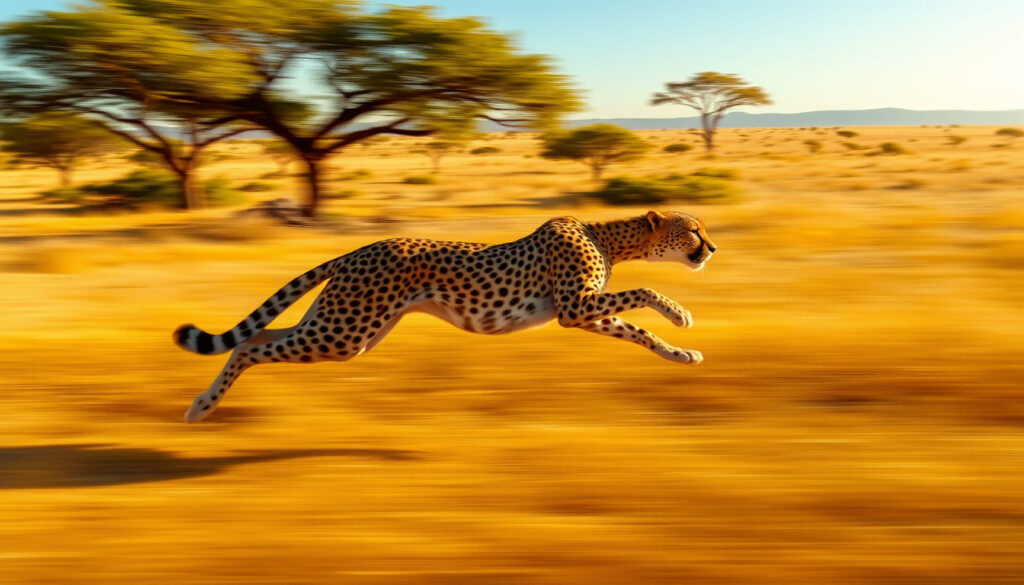
How Fast Can a Cheetah Run? Speed Facts & Comparisons
If you’ve ever watched a cheetah explode across the savanna, that split-second burst looks almost unreal—like a nature documentary cheating with CGI. The numbers behind that blur are just as startling. Researchers have pinned the cheetah’s top speed somewhere between 68 and 75 mph, and what makes that figure even more remarkable is how quickly they reach it. This piece cuts through the mythology to separate what’s been measured in the field from what remains unverified, then stacks those numbers against human benchmarks including Usain Bolt’s world record.
Top speed: up to 75 mph (120 km/h) · Acceleration: 0-60 mph in 3 seconds · Average speed: 40 mph (64 km/h) · Sprint distance: up to 500 meters · Fastest land animal: cheetah
Quick snapshot
- Top speed: 68-75 mph per field measurements (Wikipedia – Fastest Animals)
- 0-60 mph in under 3 seconds (Wikipedia – Fastest Animals)
- 104 km/h (65 mph) over 201.2 meters (Wikipedia – Fastest Animals)
- Whether wild cheetahs hit higher top speeds than captive individuals
- Whether a cheetah has ever genuinely reached 100 mph
- Whether Asiatic cheetahs differ in speed from African subspecies
- 2009: Usain Bolt sets 100m record at 9.58 seconds, peak 44.35 km/h
- 2023: Kelvin Kiptum breaks marathon record at 2:00:35
- Cheetah 104 km/h measured over 201.2m course (date unspecified)
- GPS tracking studies may refine wild-speed estimates
- Conservation work depends on understanding sprint needs
- Biomechanics research continues on cheetah gait efficiency
These key metrics establish the boundaries of what cheetah locomotion can achieve under measured conditions.
| Metric | Measured value |
|---|---|
| Maximum burst speed | 75 mph (120 km/h) |
| Acceleration 0-60 mph | 3 seconds |
| Stride length at top speed | 7 meters |
| Sustained chase speed | 40 mph |
Can cheetahs go 100 mph?
The 100 mph figure pops up regularly in popular media, but wildlife researchers have never confirmed a cheetah reaching that threshold under measured conditions. The African Wildlife Foundation describes cheetahs as capable of “up to 70 mph,” which aligns closely with the 109.4–120.7 km/h range (68–75 mph) documented across multiple scientific compilations. The highest rigorously measured speed sits at 104 km/h (approximately 65 mph) recorded over a 201.2-meter course, according to Wikipedia’s Fastest Animals analysis, which aggregates timing studies and field observations.
Myth origins
Where does the 100 mph claim come from? Much of it traces to early estimates and anecdotal accounts from the 1950s and 1960s, before scientists had access to high-speed cameras and GPS tracking. A cheetah running flat-out looks so fast that observers naturally round up. Some media outlets then amplified those rounded figures over decades until they became entrenched in public consciousness. The cheetah’s slender frame and ground-spoiling running style create a visual illusion of even greater speed than the numbers support—which are extraordinary enough on their own.
Actual recorded speeds
Researchers who have worked with captive cheetahs on timed runs report bursts in the 60-70 mph range consistently. The African Wildlife Foundation confirms the species as “the world’s fastest land animal,” with maximum speeds around 70 mph. No peer-reviewed study has documented a cheetah exceeding 80 mph. The theoretical upper limit for a animal of cheetah’s body mass and musculoskeletal design sits around 75 mph, which explains why the observed ceiling clusters in the high 60s to mid-70s across independent measurements.
Has a cheetah ever reached 75 mph?
The short answer: probably, but scientists consider 75 mph more of an upper bound than a regularly observed figure. The verified data shows cheetahs reliably reaching 104 km/h (65 mph) over 201.2 meters. Some timed runs at private facilities have reportedly approached 70 mph, but those measurements lack the independent verification that scientists prefer. The Handy Science Answer Book cites cheetah speeds “timed at 70 mph over short distances,” which falls within the established range.
Record evidence
What counts as evidence here? Researchers typically rely on three methods: radar guns (similar to traffic enforcement), high-speed film analysis frame-by-frame, and GPS logger data from tracked animals. The 104 km/h figure comes from timed runs where cameras and calibrated equipment documented the cheetah’s position over known distances. Speed estimates above that threshold come from less-controlled scenarios—often estimates by observers rather than instrumented measurements. Conservation biologists note that cheetahs in the wild may run faster than test conditions allow because they’re motivated by actual prey, not rewards.
Measurement methods
The most credible speed studies involved cheetahs running along measured tracks while cameras recorded their position at fixed intervals. Researchers then calculated velocity by dividing distance by time. This approach eliminates the guesswork from visual estimates. The Smithsonian’s biomechanics research on cheetah locomotion has contributed significantly to understanding their gait mechanics, showing how their spine acts like a spring that stores and releases energy with each stride. Their studies on cheetah speed provide the physiological basis for why these animals can reach such velocities despite their relatively modest body size.
What is the top 5 fastest animal?
When ranking the fastest animals on Earth, the context matters enormously: land, sea, and air each have their own champions, and comparing across these domains is like asking whether a submarine is faster than a jet fighter. On land, the cheetah holds the crown. The Wikipedia – Fastest Animals page aggregates speed data across categories, showing where the cheetah stands relative to other animals.
Land rankings
The top land speeds show a clear hierarchy: the cheetah maxes out around 75 mph, followed by the pronghorn antelope at roughly 55 mph. The pronghorn cannot outrun a cheetah in a sprint, but it can sustain 40 mph over distances that would force a cheetah to quit. The lion reaches around 50 mph during hunts, though most sources cite lower figures. Ostriches hit 61 km/h (38 mph) on the ground, making them the fastest bird on land. Even these comparatively lower figures put most predators well ahead of human athletes.
Cheetah position
Cheetahs dominate the land-speed rankings for one key reason: they sacrifice almost everything else for raw acceleration. Their lightweight frame (110-140 pounds at 30 inches shoulder height, per the African Wildlife Foundation), semi-retractable claws, and enlarged adrenal glands all support short explosive sprints. They are built to close distance quickly within a small radius. The trade-off is durability: their bodies cannot sustain that output for long before overheating, which is why hunts almost always fail if the chase extends beyond 500 meters or 60 seconds.
The speed gap between cheetahs and other land animals reflects their specialized evolutionary compromise—maximum acceleration traded against sustainability.
| Animal | Top speed | Category |
|---|---|---|
| Cheetah | 75 mph (120 km/h) | Land mammal |
| Pronghorn | 55 mph (88 km/h) | Land mammal |
| Lion | 50 mph (80 km/h) | Land mammal |
| Ostrich | 38 mph (61 km/h) | Land bird |
| Peregrine falcon | 242 mph (390 km/h) | Air (diving) |
Is it possible for a human to outrun a cheetah?
In a sprint, absolutely not. In an endurance race, the cheetah loses every time. Understanding why requires looking at the cheetah’s acceleration profile compared to human performance data. The Wikipedia – Fastest Animals compilation includes both human benchmarks and animal comparisons that make the gap clear.
Sprint vs endurance
The cheetah reaches 60 mph in under three seconds. Usain Bolt, the fastest human sprinter ever recorded, hit a peak of 44.35 km/h (27.56 mph) at the 52.51-meter mark during his 9.58-second 100m world record in 2009. That’s less than half the cheetah’s top speed and it took Bolt most of the race to get there. Average humans run closer to 18 km/h (11 mph) over longer distances, according to Wikipedia – Fastest Animals. The Handy Science Answer Book notes that “humans max short distance speed nearly 28 mph,” but that’s a theoretical ceiling most people never approach.
Usain Bolt comparison
To make the comparison concrete: Bolt’s world-record 100m took 9.58 seconds. A cheetah covers 100 meters in roughly 3 seconds at top speed. At his peak velocity, Bolt covered 52.51 meters in the time it takes a cheetah to nearly finish the race. The World Atlas analysis emphasizes that cheetahs “can only maintain top speed for short distances before overheating”—but that short distance is long enough to cover 100 meters well before any human.
How fast can a cheetah run in mph?
The most defensible answer based on current research: cheetahs reach 65-75 mph in bursts, average around 40 mph during actual hunts, and can only maintain top speed for approximately 60 seconds before physiological limits force a slowdown. These figures come from multiple sources including the Wikipedia – Fastest Animals analysis, the African Wildlife Foundation, and biomechanics research documented by the Smithsonian.
Top speed details
The cheetah’s top speed of 109.4–120.7 km/h (68.0–75.0 mph) represents the upper range of what’s been documented across timing studies and field observations. Not every cheetah reaches 75 mph, and not every sprint hits the maximum. The World Atlas notes that cheetahs “reach 60-70 mph (96-112 km/h)” in typical high-speed bursts, which is probably the most accurate single figure. What distinguishes the cheetah is not just the number but how quickly they get there.
Acceleration facts
Acceleration separates the cheetah from other fast animals more than top speed does. The cheetah reaches 97 km/h (60 mph) from a standing start in less than three seconds—a figure that rivals sports cars. The Handy Science Answer Book reports it “accelerates from 0 to 45 mph in two seconds.” This explosive launch comes from a gait pattern where all four feet leave the ground briefly—the “gathered and extended” stride that other big cats cannot replicate at equivalent speeds.
Endurance limits
The same features that make cheetahs explosive also make them fragile sprinters. Their large adrenal glands pump out stress hormones that fuel short bursts, but the metabolic cost is enormous. The body temperature spikes rapidly, and the cardiovascular system cannot supply oxygen fast enough to sustain the effort. World Atlas confirms that “cheetahs can only maintain top speed for short distances before overheating.” Most wild chases last 30-60 seconds, after which the cheetah must rest or abandon the hunt entirely. They typically average 40 mph (63 km/h) during actual hunts, per the Handy Science Answer Book. While the cheetah’s speed is impressive, it’s worth noting that even everyday items have their own fascinating histories, like the Coca-Cola Mythos Kokain Geschichte.
Confirmed
- Cheetah top speed: 68-75 mph (verified by multiple sources)
- 0-60 mph acceleration: under 3 seconds
- 104 km/h (65 mph) reliably measured over 201.2m
- Endurance limited to ~60 seconds at top speed
- Usain Bolt peak speed: 27.56 mph
- Pronghorn sustains 40 mph longer than cheetah’s sprint
- Peregrine falcon reaches 242 mph in dives
Unverified claims
- 100 mph cheetah speed (no peer-reviewed evidence)
- Wild cheetahs definitively faster than captive specimens
- Precise speed differences between African and Asiatic subspecies
The cheetah can accelerate from 0 to 97 km/h in less than three seconds, faster than a Ferrari.
— Wikipedia editors, summarizing animal speed research
Cheetahs are the world’s fastest land animal, capable of reaching speeds of up to 70 mph.
— African Wildlife Foundation, conservation organization
His absolute fastest speed during that sprint was 44.35 km/h (27.56 mph) at 52.51 metres.
— Wikipedia on Usain Bolt’s 2009 world record
The cheetah’s biology makes it a specialist at explosive acceleration, but that same specialization creates vulnerability when habitat fragmentation forces longer pursuit distances that the animal cannot physically sustain.
Conservation planners must account for cheetah sprint limitations when designing protected areas, since these predators require prey populations dense enough to support short chases within the 500-meter maximum chase distance.
Related reading: Can Dogs Eat Peas · Hermit Crab Without Shell
Frequently asked questions
How fast can a cheetah accelerate?
A cheetah accelerates from 0 to 60 mph in less than three seconds. Some sources report 0 to 45 mph in just two seconds. This acceleration comes from a specialized spinal structure and semi-retractable claws that grip the ground during the gathered-and-extended stride pattern.
What limits a cheetah’s speed?
Body temperature rises rapidly during sprints, causing overheating after roughly 60 seconds. The cardiovascular system cannot supply oxygen fast enough to sustain maximum output. Additionally, the lightweight frame that enables fast acceleration lacks the stamina for prolonged chases.
How does cheetah speed compare to lions?
Lions reach around 50 mph during hunts, well behind the cheetah’s 65-75 mph maximum. However, lions are built for endurance and cooperative hunting, often pursuing prey over longer distances before the final burst.
Can cheetahs maintain top speed long?
No. Cheetahs can only sustain top speed for approximately 60 seconds before overheating forces them to slow down. Most hunts involve much shorter bursts at maximum speed, with cheetahs averaging around 40 mph during actual pursuits.
What adaptations enable cheetah speed?
Key adaptations include a flexible spine that acts like a spring, semi-retractable claws for grip, large adrenal glands for stress-hormone surges, a lightweight frame (110-140 pounds), and aerodynamic features including a small skull and streamlined body.
How is cheetah speed measured?
Researchers use radar guns, high-speed cameras at fixed positions, and GPS loggers. The most credible measurements come from timed runs along measured tracks where cameras document position over known distances and calibrated equipment records velocity directly.
Do cheetahs run faster uphill?
No. Like most quadrupeds, cheetahs slow on inclines because their acceleration-dependent hunting style loses effectiveness. Downhill sections can actually increase their speed, but wild cheetah habitats rarely feature significant elevation changes that meaningfully affect chase dynamics.
For anyone comparing animal speeds—whether for academic curiosity, wildlife photography, or just settling a bet—the cheetah’s record stands firm on land at 75 mph peak and roughly 65 mph over measured distances. The comparison to human athletes makes the gap feel even larger: Bolt’s world record pace would leave a cheetah waiting at the finish line. The real limitation is not top speed but duration: when the cheetah’s temperature spikes after a minute of flat-out running, the hunt ends one way or another. Understanding that trade-off explains both why cheetahs are so successful in short chases and why they remain vulnerable to habitat changes that force longer pursuits they simply cannot win.
More related posts
 General Motors V8 Engine Lawsuit – Affected Vehicles and Updates
 Trump Address to Congress 2025: Transcript, Recap & Video
 Wells Fargo Active Cash Card Review 2025
 Things to Do in Colorado: Top Attractions & Guides
 Utah Jazz vs Warriors Player Stats: Curry’s 31-Point Return
 Pass the Dutchie Lyrics: Meaning, Origin, and Slang Explained
 What Does ‘FN’ Mean in Text? Slang, Keyboard & Gaming Guide
 Who Will Be the Next Pope – Candidates, Conclave Rules and Timeline
