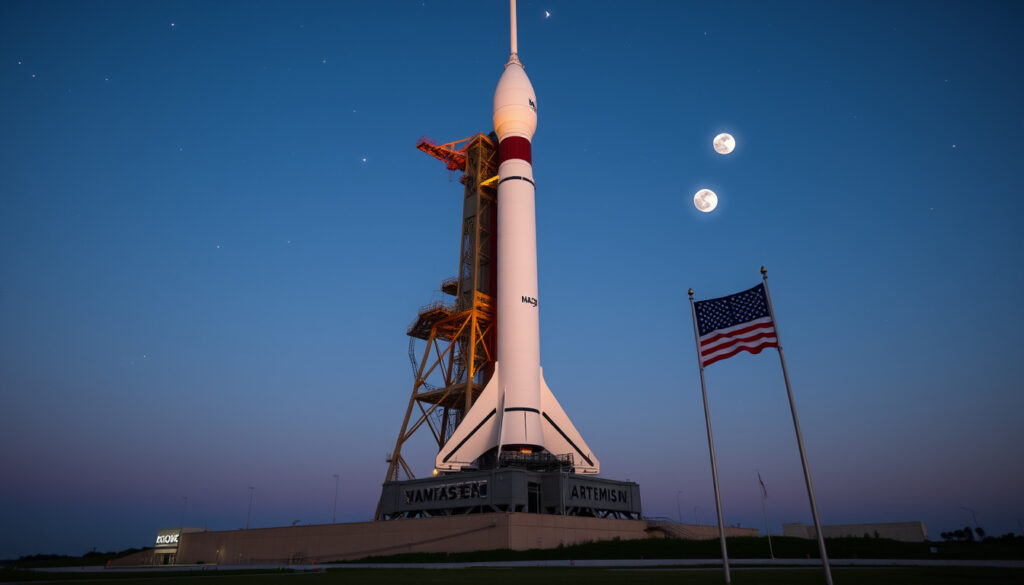
Artemis 2 Launch Date: April 1, 2026 – NASA Mission Recap
Artemis II lifted off from Kennedy Space Center on April 1, 2026, breaking a 54-year streak of humans confined to low Earth orbit. After years of planning, hardware checkouts, and more than a few weather-related setbacks, four astronauts rode the Space Launch System toward the Moon on a path no crewed mission has taken since Apollo 17.
Launch Date: April 1, 2026 · Launch Time: 6:35 p.m. EDT · Launch Site: Kennedy Space Center, LC-39B · Rocket: Space Launch System (SLS) · Splashdown Date: April 10, 2026
Quick snapshot
- Launch on April 1, 2026 from Launch Complex 39B at 6:35 p.m. EDT (NASA Artemis II Launch Day Updates)
- Four astronauts: Reid Wiseman, Victor Glover, Christina Koch, Jeremy Hansen (NASA Artemis II Launch Day Updates)
- Splashdown on April 10, 2026 in the Pacific Ocean off San Diego (Space.com Artemis 2 Splashdown Updates)
- Detailed technical reasons behind each individual delay phase beyond weather and schedule shifts
- Specific lunar orbit parameters and closest approach distance during the flyby
- Concrete Artemis III target launch date following the success of Artemis II
- Original target: February 5, 2026 window, announced September 2025 (Wikipedia – Artemis II)
- Countdown clock started March 30, 2026 at 4:44 p.m. EDT (NASA Artemis II Countdown Begins)
- Crew arrived at Kennedy Space Center March 27, 2026 (Wikipedia – Artemis II)
- Artemis III targets the first crewed lunar landing since Apollo 17
- International partnership with Canadian Space Agency continues via Jeremy Hansen’s participation
- Mission data from Artemis II will inform next-generation SLS and Orion upgrades for extended deep-space missions
Mission data in table form provides a quick reference for key parameters.
| Field | Value |
|---|---|
| Status | Completed |
| Launch Date | April 1, 2026 |
| Crew Return | April 10, 2026 |
| Vehicle | Orion on SLS |
| Objective | Lunar orbit test |
What date is Artemis 2 set to launch?
Artemis II launched on April 1, 2026, at 6:35 p.m. EDT from Launch Complex 39B at Kennedy Space Center in Florida — marking the first crewed departure from that pad since STS-116 in 2006 (NASA Artemis II Launch Day Updates). The mission ran approximately 10 days before the Orion capsule returned to Earth.
Launch time and location
The lift-off occurred at 22:35:12 UTC (6:35:12 p.m. EDT), with the integrated SLS rocket, Orion capsule, and launch tower departing from the Vehicle Assembly Building on January 18, 2026, then rolled out to Launch Pad 39B on March 18-19, 2026 (Wikipedia – Artemis II). Seven two-hour launch windows had been announced for April 1–6 and April 30 after a Flight Readiness Review on March 12, 2026.
Countdown details
The official countdown began on March 30, 2026, with the onsite clock starting at 4:44 p.m. EDT and targeting a launch window of 6:24 p.m. the following day — a timeline NASA had committed to completing no later than the end of March 2026 (NASA Artemis II Countdown Begins).
That April 1 launch date was itself a move from an earlier target: February 5, 2026. Mainstream outlets including NASASpaceflight, journalist Eric Berger, and U.S. Senator Mark Kelly had reported the shift to February as early as August 2025, with officials formally announcing the revised window in September 2025.
Why did Artemis 2 get delayed?
Artemis II’s schedule slipped from a planned March 2026 launch to March 2026 through a combination of technical readiness reviews and a significant weather event in March 2026. The delays reflected the cautious pace NASA maintains when launching humans on a new rocket system for the first time.
Key delay reasons
Launch preparations faced disruption from the March 2026 North American winter storm, which affected rollout logistics at Kennedy Space Center (Wikipedia – Artemis II). By August 2025, reports from NASASpaceflight, Eric Berger, and U.S. Senator Mark Kelly indicated the mission had been pushed from its original late-2025 target to February 2026, with officials announcing the shift publicly in September 2025.
NASA structural changes
The Flight Readiness Review conducted on March 12, 2026, identified seven two-hour launch windows across April 1–6 and April 30, signaling that while NASA was cleared to fly, the agency maintained conservative scheduling margins. The Artemis II mission marked the first crewed flight of the SLS rocket and the Orion spacecraft — both relatively new systems for human passengers.
NASA had previously committed publicly to launching Artemis II no later than the end of March 2026 — a political and programmatic deadline that made the successful April 1 liftoff a narrowly avoided slip into that final window. The agency ultimately beat that deadline, but by the narrowest of margins.
Is Artemis 2 actually going to land on the moon?
No. Artemis II is a crewed orbital test mission, not a landing attempt. The four astronauts flew the Orion spacecraft around the Moon on a free-return trajectory, then came straight back — no touchdown, no lunar surface operations.
Mission profile
The mission’s goal was to verify modern human capabilities in deep space and pave the way for long-term exploration on the lunar surface, as noted by the Kennedy Space Center Visitor Complex (Kennedy Space Center Visitor Complex). Artemis II was the first crewed flight of both the Space Launch System rocket and the Orion spacecraft, carrying humans beyond low Earth orbit for the first time since Apollo 17 in 1972.
Orbital path only
Artemis II departed Earth’s orbit on a trajectory toward the Moon, completing a lunar flyby before heading home. The Orion capsule was named “Integrity” by the crew — a choice that reflected their stated commitment to the mission’s purpose of proving out the systems that will eventually support longer stays on the lunar surface.
How long will Artemis II take to reach the moon, and what happens next?
The mission lasted approximately 10 days from launch to splashdown, with the crew covering roughly 860,000 miles over that stretch. Key moments included the initial trans-lunar injection burn, a lunar flyby at variable distance, and a high-speed reentry into Earth’s atmosphere.
Travel duration
Artemis II’s timeline ran from a March 30 countdown start through the April 1 launch, with the crew spending roughly a week in cislunar space before beginning the return leg. The mission splashdown occurred on Friday, April 10, 2026, with the Orion capsule entering Earth’s atmosphere at 7:53 p.m. EDT (2353 GMT), splashing down 14 minutes later in the Pacific Ocean off the San Diego coast.
Mission phases post-launch
The reentry speed was a point of interest: Apollo 10 still holds the human spaceflight speed record at 36,397 feet per second (24,816 mph or 39,938 kph), set during its return on May 26, 1969. Artemis II was not expected to break that record, as its trajectory and mass properties did not produce comparable reentry velocities.
What Is Artemis II?
Artemis II was the first crewed flight of NASA’s Artemis program and the first time humans traveled beyond low Earth orbit since the Apollo era. It was designed as a full-up test of the SLS rocket, Orion spacecraft, and ground systems with a live crew aboard.
Crew details
The mission carried four astronauts: NASA Commander Reid Wiseman, NASA Pilot Victor Glover, NASA Mission Specialist Christina Koch, and Canadian Space Agency Mission Specialist Jeremy Hansen (NASA Artemis II Launch Day Updates). Jeremy Hansen’s inclusion marked a milestone for international cooperation, as CSA had not put a human in deep space on a NASA-led mission before. The crew arrived at Kennedy Space Center on March 27, 2026, ahead of final pre-launch activities.
Rocket and objectives
Artemis II was the first crewed flight of the Space Launch System (SLS) rocket and the first crewed flight of the Orion spacecraft — both developed over the past decade specifically for NASA’s lunar ambitions. The mission goal was to verify modern human capabilities in deep space and demonstrate the viability of the hardware before committing to a crewed landing on Artemis III.
Artemis II succeeded in doing exactly what a first crewed mission of a new system should: it flew, it flew safely, and it brought its crew home. For NASA, that is a significant data point — but the program’s next test, an actual lunar landing, carries stakes that a flyby simply cannot match.
Artemis II Mission Timeline
The timeline below summarizes key milestones from planning through splashdown.
| Date | Event |
|---|---|
| March 2026 | Mainstream outlets report Artemis II moved from late 2025 to March 2026 |
| March 2026 | NASA announces pursuit of February 5, 2026 launch window |
| March 2026 | North American winter storm delays launch preparations |
| January 18, 2026 | Integrated SLS rocket, Orion capsule, and launch tower rolled out to LC-39B |
| March 12, 2026 | Flight Readiness Review; seven two-hour windows announced for April 1–6 and April 30 |
| March 18–19, 2026 | Artemis II rolled out to Launch Pad 39B |
| March 27, 2026 | Crew arrives at Kennedy Space Center |
| March 30, 2026 | Countdown clock starts at 4:44 p.m. EDT, targeting 6:24 p.m. launch on April 1 |
| April 1, 2026 | Liftoff at 6:35 p.m. EDT; trans-lunar injection burn |
| April 1–10, 2026 | Cislunar operations; lunar flyby |
| April 10, 2026 | Orion reentry and splashdown off San Diego coast |
What the timeline shows is a program that navigated multiple schedule adjustments while maintaining its core commitment to crew safety — and ultimately delivered a mission that broke a 54-year streak of no humans beyond low Earth orbit.
Confirmed vs. Unconfirmed
Confirmed facts
- Launch on April 1, 2026 at 6:35:12 p.m. EDT from LC-39B (NASA)
- Four astronauts: Wiseman, Glover, Koch, Hansen
- First crewed SLS and Orion flight
- First crewed mission beyond LEO since Apollo 17 (1972)
- Splashdown April 10, 2026 off San Diego
- Mission duration: 10 days
What’s still unclear
- Specific technical causes behind each individual delay phase beyond weather
- Exact lunar orbit parameters and closest approach during flyby
- Concrete Artemis III target launch date
- Post-mission technical findings from Orion heat shield analysis
What Experts Are Saying
“For the first time since 1972, NASA sent humans back on a path toward the Moon with Artemis II.”
“The mission goal was to verify modern human capabilities in deep space and pave the way for long-term exploration and science on the lunar surface.”
The consensus among mission observers is that Artemis II proved the hardware works in a crewed context — a gate that had been theoretical until April 1. What it did not prove is that the next step, a crewed landing, will arrive on schedule or within the program’s evolving budget picture.
Related reading: Speed Facts & Comparisons · AMD Ryzen 7 7800X3D Review
Artemis 2’s April 1, 2026, liftoff from Kennedy Space Center incorporates key timelines from the Artemis rocket launch schedule amid ongoing program preparations.
Frequently asked questions
Has any human left Earth’s orbit?
Before Artemis II, no human had traveled beyond low Earth orbit since Apollo 17 returned to Earth in December 1972. That 54-year gap ended when the Artemis II crew completed their lunar flyby in March 2026.
Will Artemis 3 still land on the moon?
Artemis III is planned as the first crewed lunar landing since Apollo 17, but its target launch date remains undetermined following Artemis II’s success. The program has not publicly committed to a specific date as of the mission’s completion.
What is the most powerful rocket ever built?
NASA’s Space Launch System (SLS) produces more thrust at liftoff than the Saturn V that launched Apollo missions. SLS Block 1 generated approximately 8.8 million pounds of thrust at launch, making it the most powerful rocket to fly humans into space to date.
Where to watch Artemis 2 launch?
NASA provided live coverage of the Artemis II launch through its official website, blog, and YouTube channel. The Kennedy Space Center Visitor Complex also hosted viewing events on site. The launch occurred on April 1, 2026.
Was the Artemis 2 mission real?
Yes. Artemis II launched on April 1, 2026, from Kennedy Space Center Launch Complex 39B, carrying four astronauts on a 10-day lunar orbit test mission before splashing down on April 10, 2026, in the Pacific Ocean.
Who was the astronaut who floated away?
This question refers to a different incident. During Artemis II, no crew member EVA’d outside the spacecraft. Astronaut tethered egress during splashdown recovery is standard protocol, but no untethered separation occurred.
What did Neil Armstrong say before his death?
Neil Armstrong died in 2012. Public statements attributed to him in later years included reflections on the importance of continuing exploration. Any specific quote should be sourced to an authenticated archive or interview record.
Artemis II proved that NASA’s modern lunar architecture works with humans aboard — a milestone that resets the baseline for what comes next. For the Artemis program, the pressure now shifts entirely to Artemis III: delivering a crewed landing that no space agency has attempted in over half a century, on a timeline and budget that remain in flux.
More related posts
 Urban Air Adventure Park: Age, Cost, Safety & Attractions
 Denise Richards Movies and TV Shows: Complete Guide
 What Is the Constitution – Definition, History & Key Principles
 She’s the Man Cast: Full List of Actors and Characters (2006)
 How to Ace the SAT: Study Plan, Score Percentiles & Strategies
 Redmi 9T to Buy: 2025 Price, Specs & Review
 Wine Bar Near Me: Best Ireland Wine Bars & Tips
 What Does ‘FN’ Mean in Text? Slang, Keyboard & Gaming Guide
