How to Wash Strawberries: Vinegar, Salt, Baking Soda Methods
Anyone who has brought home strawberries, washed them all at once, and then watched them turn soft by day three already knows the real issue: water is the enemy. The U.S. Food and Drug Administration (federal produce-safety guidance) recommends a cool running-water rinse before eating, but when you wash matters just as much as how.
Best basic wash: Cold running water in a colander ·
Vinegar-to-water ratio: 1/4 cup vinegar to 1 1/2 cups water ·
Recommended soak time: About five minutes ·
Never wash with: Soap, detergent, or bleach
Quick snapshot
- Strawberries are best washed right before eating or preserving, not right after purchase (University of California Agriculture and Natural Resources (postharvest research)).
- Whether saltwater soaks actually remove bugs better than plain running water is still more internet lore than settled science (Real Simple (home-wash method guide)).
- A quick vinegar soak runs about five minutes, while longer acidic baths risk softer fruit (Food Network (test-kitchen guidance)).
- After any rinse or soak, drain and dry the berries completely; moisture is the main spoilage risk (Epicurious (test-kitchen editors)).
Five quick facts, one pattern: the simplest wash is the safest, and every extra ingredient trades time for a specific goal.
| Label | Value |
|---|---|
| Basic wash | Cold running water in a colander (University of California Agriculture and Natural Resources postharvest research) |
| Vinegar-to-water ratio | 1/4 cup vinegar to 1 1/2 cups water (Berries.com berry storage guide) |
| Common soak time | About 5 minutes (Real Simple home-wash method guide) |
| Never wash with | Soap, detergent, or bleach (U.S. Food and Drug Administration produce-safety guidance) |
| Storage rule | Dry berries before refrigerating (University of California Agriculture and Natural Resources postharvest research) |
How to wash and store berries?
Quick colander rinse
- Pick out bruised or moldy berries before washing them.
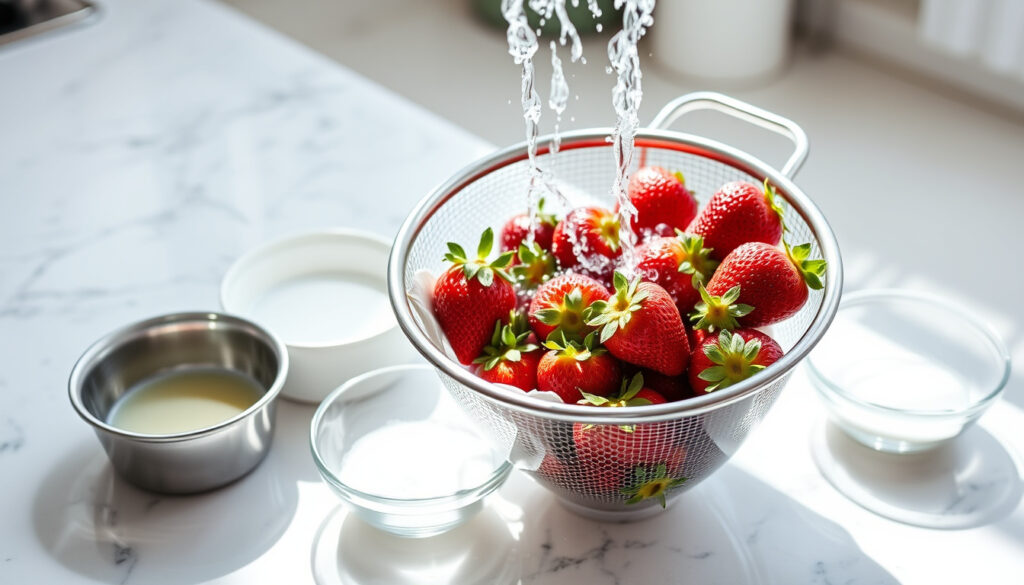
- Set the berries in a clean colander and rinse under cool running water while rubbing each one gently with your fingers.
- Drain the colander well, then pat the berries dry with a clean paper towel.
Epicurious’s test-kitchen editors call this the easiest and most effective way to clean strawberries (Epicurious test-kitchen editors). Food Network’s guide gives the same advice: cool running water, a gentle rinse, and no soap or detergent (Food Network test-kitchen guidance).
Dry before storing
Wash strawberries only when you’re about to eat or preserve them, and always dry them completely before they go in the fridge. University of California postharvest researchers say washing adds moisture, and moisture makes berries spoil faster (University of California Agriculture and Natural Resources postharvest research).
The implication: a colander and a clean towel are the real starter kit. Everything else is optional.
What’s the best thing to wash berries in?
Plain-cold-water method
- Use cool water, not warm or hot.
- Rub each berry gently while rinsing.
- Pat dry before eating or storing.
This is the baseline the U.S. Food and Drug Administration produce-safety guidance recommends for all produce. It removes dirt and surface grit without changing flavor.
Vinegar-water method
- Use roughly 1/4 cup vinegar to 1 1/2 cups water.
- Soak about five minutes, then drain.
- Rinse with clean water afterward.
The quick vinegar soak is a common fridge-life trick (Berries.com berry storage guide), but the Food Network test-kitchen guidance notes that vinegar soaking is not a safety requirement and should stay short.
Pantry alternative methods
- Baking soda: about 1 teaspoon per 4 cups of water, soaked 10 to 15 minutes.
- Salt: about 1 tablespoon of salt in warm water, soaked about five minutes.
- All pantry soaks need a final clean-water rinse.
Real Simple’s wash guide lists both as published pantry methods (Real Simple home-wash method guide). Choose them for a deeper clean, not as a replacement for running water.
The pattern: plain water is the fastest, vinegar adds a mold-fighting step, and salt or baking soda add a deeper-but-slower clean.
The timing-first approach applies across all methods: pick your wash based on when you plan to serve the berries.
How long to soak strawberries when washing?
Five-minute vinegar soak
- A quick vinegar soak is commonly described as about five minutes (Berries.com berry storage guide).
- Some detailed guides use a longer ratio of 4 parts water to 1 part vinegar and a 20-minute soak (Real Simple home-wash method guide).
- Baking soda soaks usually land between 10 and 15 minutes.
Over-soaking warning
Long water baths can waterlog berries and dull their texture. Food Network’s test-kitchen guidance says a quick vinegar dunk beats a prolonged acidic soak (Food Network test-kitchen guidance).
For plain cold water, there is no soak: a quick rinse with gentle rubbing is enough.
The trade-off: longer soaks clean deeper but cost texture. Keep the clock short unless you are using baking soda in the 10-to-15-minute range.
What do you soak strawberries in to get the bugs out?
Saltwater soak
- Use about 1 tablespoon of salt in warm water.
- Soak for about five minutes.
- Rinse each berry under clean running water afterward.
This is the method people search for when they spot tiny bugs or larvae. Real Simple’s guide includes the saltwater ratio (Real Simple home-wash method guide), and Food Network notes that saltwater is widely promoted for this purpose but that no authoritative source establishes it as necessary or better than running water (Food Network test-kitchen guidance).
Rinse after soaking
- Soaking loosens grit and residue; it doesn’t remove it by itself.
- Run each berry under cool water after the salt bath.
- Dry on a clean towel before serving.
The pattern: a salt bath is a visual check, not a magic eraser. The final rinse does the real lifting.
Should I wash strawberries before storing?
Why timing matters
Washing before storage adds moisture to the surface, and that moisture shortens shelf life. University of California Agriculture and Natural Resources recommends washing just before eating or preserving (University of California Agriculture and Natural Resources postharvest research).
So the short answer is no: don’t wash the whole punnet and park it in the fridge. Wash only what you plan to eat soon, or dry everything very well after washing.
Glass vs. plastic storage
- Glass and plastic both work for strawberries.
- Dry berries matter more than the container material.
- Add a paper towel to absorb extra moisture.
There is no strong evidence that glass beats plastic or the reverse when the berries are dry. The U.S. Food and Drug Administration produce-storage guidance simply says to keep produce refrigerated at 40°F or below.
The implication: container debates are a distraction. If the berries are dry and cold, you’re ahead of most people.
How to keep strawberries fresh with vinegar?
Vinegar-to-water ratio
- Use 1/4 cup vinegar with 1 1/2 cups water.
- Soak for about five minutes, then drain.
- Rinse briefly with clean water.
This is the quick soak formula that Berries.com’s berry storage guide recommends to help strawberries last longer in the fridge (Berries.com berry storage guide).
Dry completely before storing
A vinegar soak only helps if you remove the moisture afterward. Berries stored wet, even after a vinegar bath, can spoil faster than unwashed berries (University of California Agriculture and Natural Resources postharvest research).
Spread the berries on a clean towel, let them air-dry, then transfer to a container lined with paper towel.
The trade-off: vinegar buys you a little time, but only if you dry the berries well enough to make that time count.
This pattern repeats across all methods: moisture management drives shelf life.
| Method | What you need | Best for |
|---|---|---|
| Cold-water rinse | Cool running water and a colander | Eating berries the same day |
| Vinegar soak | 1/4 cup vinegar to 1 1/2 cups water, about 5 minutes | Adding a little fridge life |
| Baking soda soak | 1 teaspoon baking soda per 4 cups water, 10–15 minutes | A vinegar-free pantry deep-clean |
| Saltwater soak | 1 tablespoon salt in warm water, about 5 minutes | When you want to check for bugs |
Pros and cons of washing strawberries
Upsides
- Removes dirt and field grit.
- Lowers the chance of surface contamination when done under running water (U.S. Food and Drug Administration produce-safety guidance).
- A short vinegar soak can help berries hold up longer in the fridge (Berries.com berry storage guide).
Downsides
- Washing before storage adds moisture and speeds spoilage (University of California Agriculture and Natural Resources postharvest research).
- Soap and detergent can be harmful and should never be used (U.S. Food and Drug Administration produce-safety guidance).
- Long vinegar soaks can change texture and flavor (Food Network test-kitchen guidance).
The pros center on immediate cleanliness; the downsides revolve around timing and moisture. The trade-off is clear.
Step-by-step: How to wash strawberries
This sequence follows the same pattern you’ll find in University of California Agriculture and Natural Resources postharvest research and Real Simple home-wash method guide.
- Sort: Discard bruised, moldy, or very soft berries.
- Rinse: Hold each berry under cool running water and rub gently.
- Soak (optional): Use your chosen soak for its recommended time.
- Rinse again: Run clean water over the berries after any soak.
- Dry: Spread on a clean towel or spin gently in a salad spinner.
- Store: Refrigerate dry berries in a container lined with paper towel.
Following these steps in order keeps the process efficient and minimizes moisture risk.
For more kitchen tips, see our guides on Dinner Ideas for Tonight and Can Dogs Eat Blueberries?.
What’s confirmed, what’s still unclear
Confirmed facts
- A cool running-water rinse is the official baseline (U.S. Food and Drug Administration produce-safety guidance).
- Washing right before eating beats washing right after purchase (University of California Agriculture and Natural Resources postharvest research).
- Soap should never be used on strawberries (U.S. Food and Drug Administration produce-safety guidance).
What’s unclear
- The optimal saltwater ratio and soak time for drawing bugs out.
- Whether baking soda soaks change texture or flavor.
- Whether glass or plastic containers have a measurable effect on shelf life.
The confirmed list anchors any washing routine; the unclear points leave room for personal testing.
What the guides say
The easiest and most effective way is to rinse strawberries under cold running water and discard bruised berries first.
Epicurious (test-kitchen editors)
Rinse under cool running water and never use soap or detergent.
Food Network (test-kitchen guidance)
Soak berries in 1/4 cup vinegar and 1 1/2 cups water for about five minutes to help them stay fresh.
Berries.com (berry storage guide)
All three sources agree on the core steps: cold water, no soap, and the option of a short vinegar soak for extended freshness.
The takeaway for your kitchen
Washing strawberries is a timing game as much as a cleaning one. Keep the berries dry until you’re ready to eat them, use cold running water for a same-day wash, and reserve the vinegar soak for when you need extra fridge life. For the home cook, the decision is clear: wash only what you’ll eat, dry everything else, or accept a shorter shelf life.
realsimple.com, fda.gov, hometosight.com, realhomes.com, healthline.com
Frequently asked questions
Is it better to wash berries?
Yes, when done right. Rinse them under cool running water just before eating or serving, and skip soap. The U.S. Food and Drug Administration recommends a cool running-water rinse for all produce (U.S. Food and Drug Administration produce-safety guidance).
Is it better to store berries in glass or plastic?
There isn’t strong evidence that glass beats plastic or the reverse. Keeping berries dry and refrigerated at 40°F or below matters more than the container material (U.S. Food and Drug Administration produce-storage guidance).
How do you wash strawberries with baking soda?
Use about 1 teaspoon of baking soda in 4 cups of water, soak for 10 to 15 minutes, then rinse each berry under clean running water and dry thoroughly (Real Simple home-wash method guide).
How do you wash strawberries with apple cider vinegar?
You can swap apple cider vinegar for white vinegar in a quick soak, then rinse and dry. Keep the soak short; Food Network’s test-kitchen guidance warns that prolonged acidic soaking can affect flavor and texture (Food Network test-kitchen guidance).
How do you wash strawberries without vinegar?
Plain cold running water is the FDA baseline. For a deeper no-vinegar clean, baking soda and saltwater soaks are pantry options, but they still need a final rinse with clean water (U.S. Food and Drug Administration produce-safety guidance).
How do you wash strawberries in a jar?
A jar method works as a gentle agitator: add water, cover, swirl, drain, then rinse. It is a popular kitchen hack, but a running-water rinse remains the more defensible baseline (University of California Agriculture and Natural Resources postharvest research).
The FAQ answers align with the article’s core guidance: start with cold water, avoid soap, and adjust soaks based on your schedule.
More related posts
 Artemis 2 Launch Date: April 1, 2026 – NASA Mission Recap
 Denise Richards Movies and TV Shows: Complete Guide
 Who Wrote the Declaration of Independence – Jefferson, Committee & Facts
 What Is Income Tax? Meaning, Calculation & Guide for Ireland 2025
 Things to Do in Colorado: Top Attractions & Guides
 Cast of Heart of Stone: Hit or Flop? Filming & Salaries Explained
 Places to Rent Near Me – Top Sites, Tips and Local Listings
 Masters of the Universe 2026: Release Date, Cast & Trailer
