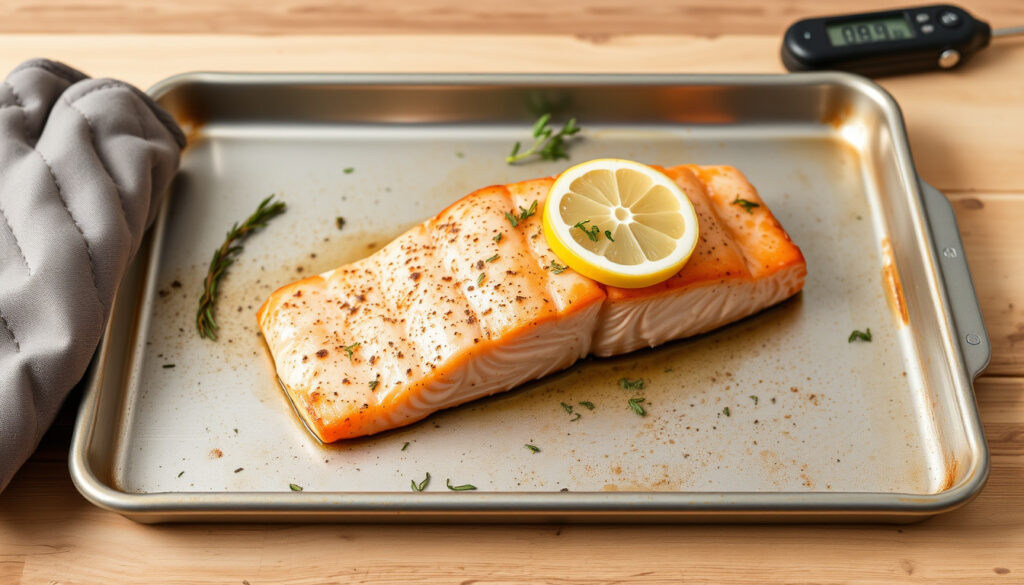
How Long to Cook Salmon in the Oven: Temperature Guide & Times
There’s a reason perfectly baked salmon is one of the most satisfying meals to pull out of the oven. But without the right temperature and timing, that tender fillet can turn dry in minutes. The key is knowing exactly how long to cook salmon in the oven—and it depends on more than just the number on the dial.
Ideal internal temperature: 145°F (63°C) ·
Minimum safe temperature: 145°F ·
Typical baking temperature: 180°C (350°F) ·
Cooking time per 1-inch thickness at 180°C: 15-20 minutes ·
Cooking time per 1-inch thickness at 200°C: 12-15 minutes
Quick snapshot
- Salmon must reach 145°F internal temperature to be safe (FDA (U.S. food safety authority)).
- Baking at 180°C for 15-20 minutes for a 1-inch fillet yields moist results (Delish (editorial recipe test kitchen)).
- Fan ovens require a 20°C temperature reduction (Laura Fuentes (home cooking blogger)).
- Whether baking at 200°C significantly reduces omega-3 fatty acid content compared to 180°C.
- Optimal resting time after baking for best texture.
- Optimal cooking time for salmon baked from frozen is not precisely established across all thicknesses.
- 350°F (180°C): 15-20 min for 1-inch fillet (Delish)
- 400°F (200°C): 12-15 min for 1-inch fillet (Laura Fuentes)
- 450°F (230°C): 8-12 min for 1-inch fillet (Laura Fuentes)
- Use an instant-read thermometer rather than relying on visual cues.
- Let salmon rest 3-5 minutes after baking for carryover cooking.
- Adjust time by 5 min per extra ½ inch of thickness.
A quick look at four critical numbers every home cook should have handy, from safety standards to practical adjustments.
| Label | Value |
|---|---|
| Safe internal temperature | 145°F (63°C) |
| Thickness adjustment | Add 5 min per extra 1/2 inch |
| Carryover cooking | 3-5°F rise after removal |
| Foil vs no foil | Foil adds 2-3 min at same temp |
How long does salmon take to cook at 180 degrees?
At 180°C (350°F), a standard 1-inch thick salmon fillet takes 15 to 20 minutes to bake through, according to Delish (editorial recipe test kitchen). That’s the sweet spot for gentle, even cooking that keeps the flesh moist without drying the exterior.
Factors affecting cooking time
- Thickness is the primary variable: a 1½-inch fillet will need about 20–25 minutes at 180°C.
- Starting temperature matters: letting the fillet rest at room temperature for 15–30 minutes before baking reduces required time by 2–4 minutes (Gimme Some Oven (home cooking blog)).
- Bone-in versus boneless: bone-in cuts cook slightly slower—add 2–3 minutes.
Cooking time for different thicknesses
The rule of thumb from Laura Fuentes (home cooking blogger) is 15–20 minutes per inch of thickness at 180°C. A ¾-inch fillet will be done in 12–15 minutes, while a 2-inch cut may need 25–30 minutes. Always verify with a thermometer.
The implication: thickness, not weight, is your real clock. A thin fillet can overcook in the time it takes to prep a side dish, so check at the lower end of the range.
How long does salmon take in the oven at 200 degrees?
At 200°C (400°F), a 6-ounce fillet of typical 1-inch thickness bakes in 12 to 15 minutes, according to Laura Fuentes (home cooking blogger). The higher temperature browns the exterior faster, creating a slight crust, but it also narrows the window between perfectly cooked and overdone.
Cooking time at 200°C (400°F)
- 1-inch fillet: 12–15 minutes
- 1½-inch fillet: 17–20 minutes
- Thin fillet (½ inch): 8–10 minutes
Adjusting for foil or no foil
Baking in foil traps steam and can add 2–3 minutes to the cook time at the same temperature. A Delish recipe uses a parchment layer between foil and lemon slices to avoid a metallic reaction. Without foil, the surface dries faster and the fillet may cook a minute or two sooner.
The pattern: higher heat means tighter margins. Use a timer, and check internal temperature at the 12-minute mark.
Overcooking isn’t just a texture problem—it affects omega-3 retention. A 4-minute delay at 200°C can mean the difference between flaky, moist salmon and a dry, crumbly fillet that loses valuable fats.
What is the biggest mistake when cooking salmon?
The most common mistake, according to McCormick (spice and seasoning brand), is overcooking. Dry, tough salmon is almost always the result of leaving it in the oven too long—or setting the temperature too high.
Overcooking and dryness
Salmon’s muscle fibers contract and squeeze out moisture when internal temperature exceeds 150°F. At 145°F, the flesh is just opaque and flakes easily. Beyond that, it turns mealy. The Black Peppercorn (food blog) recommends pulling the salmon at 145°F and letting carryover cooking finish the job.
Skipping temperature measurement
Visual cues like flaking are unreliable. The only foolproof method is an instant-read thermometer. Gimme Some Oven (home cooking blog) advises inserting the probe at the thickest part and aiming for 145°F. Test early—the last 2–3 minutes make all the difference.
The catch: even experienced cooks overestimate doneness. A thermometer removes the guesswork and saves dinner.
Salmon in the oven: better at 200°C (390°F) or 180°C (355°F), and why?
There’s no single “best” temperature—each suits a different goal. Laura Fuentes (home cooking blogger) summarizes the trade-off: 180°C gives gentle, even cooking for thicker fillets, while 200°C produces a crispy exterior and shorter cook time for thinner pieces.
Texture and moisture differences
At 180°C, the heat penetrates slowly enough that the interior and exterior cook at similar rates, resulting in uniformly moist flesh. At 200°C, the outside browns before the center is fully done, which can lead to a dry outer layer if you wait for the centre to reach 145°F.
Recommended scenarios for each temperature
- 180°C (350°F): Best for fillets thicker than 1½ inches, or when using foil to steam.
- 200°C (400°F): Ideal for thin fillets (½–1 inch) or when you want a golden crust and faster cooking.
The trade-off: if you value moisture above all, choose 180°C. If speed and crispness matter more, 200°C works—but watch the clock closely.
For the home cook, the single most valuable tool is a reliable thermometer. Without it, even the best timing tables are guesses. With it, you can cook salmon confidently at any temperature.
How to cook salmon in a fan oven?
Fan ovens circulate hot air, cooking faster and more evenly. According to Laura Fuentes (home cooking blogger), you should reduce the temperature by 20°C (20°F) compared to a conventional oven. That means 160°C for a standard bake, or 180°C for a faster roast.
Adjusting temperature for fan ovens
- Conventional 180°C → Fan 160°C
- Conventional 200°C → Fan 180°C
- Conventional 220°C → Fan 200°C
Cooking time differences
Because fan ovens cook faster, start checking internal temperature 3–5 minutes earlier than the recipe says. The same 1-inch fillet that takes 15–20 minutes in a conventional oven at 180°C may be done in 12–15 minutes in a fan oven at 160°C. The target internal temperature remains 145°F.
What this means: owning a fan oven gives you flexibility, but only if you compensate with a lower setting. Without that adjustment, you risk overcooking before you even measure.
Temperature comparison: 180°C vs 200°C vs fan oven
Three common oven setups, one pattern: lower heat for thicker cuts, higher heat for thinner ones. Fan ovens trade raw temperature for air movement.
| Oven setting | Cook time (1-inch fillet) | Texture outcome | Best for |
|---|---|---|---|
| 180°C (350°F) conventional | 15–20 min | Moist, evenly cooked | Thick fillets, foil-wraps |
| 200°C (400°F) conventional | 12–15 min | Crispy exterior, slightly drier interior | Thin fillets, quick meals |
| 160°C (320°F) fan | 12–15 min | Very moist, gentle cooking | All thicknesses when using fan |
The pattern: lower temperatures suit thick cuts and gentle cooking, while higher temperatures work for thin fillets when speed is paramount.
Step-by-step: how to bake salmon in the oven
- Preheat the oven to your chosen temperature (180°C or 200°C conventional, or 160°C fan).
- Prepare the fillet: Pat dry, season with salt, pepper, and oil. Let rest 15–30 minutes at room temperature for even cooking (Gimme Some Oven (home cooking blog)).
- Line a baking sheet with foil or parchment paper. For extra moisture protection, use both as a Delish recipe advises.
- Bake for the time indicated by thickness and temperature (see table above).
- Check internal temperature with an instant-read thermometer at the thickest point. Target 145°F (Gimme Some Oven (home cooking blog) references FDA recommendation).
- Rest for 3–5 minutes before serving. Carryover cooking will raise the internal temperature 3–5°F (The Black Peppercorn (food blog)).
For the home cook, the single most valuable tool is a reliable thermometer. Without it, even the best timing tables are guesses. With it, you can cook salmon confidently at any temperature.
The implication: following this sequence turns a risky process into a repeatable success.
What’s confirmed and what’s unclear
Confirmed facts
- Salmon must reach 145°F internal temperature to be safe (FDA (U.S. food safety authority)).
- Baking at 180°C for 15–20 minutes for a 1-inch fillet yields moist results (Delish (editorial recipe test kitchen)).
- Fan ovens require a 20°C temperature reduction (Laura Fuentes (home cooking blogger)).
What’s unclear
- Whether baking at 200°C significantly reduces omega-3 fatty acid content compared to 180°C.
- Optimal resting time after baking for best texture.
- Optimal cooking time for salmon baked from frozen is not precisely established across all thicknesses.
The bottom line: the science behind baking salmon is solid on safety and basic timing, but fine points like omega-3 loss and resting remain open questions.
Expert perspectives on baking salmon
“Baked salmon should be roasted until just opaque in the centre—10 to 15 minutes at 200°C is usually enough for a standard fillet.”
— BBC Good Food (editorial recipe team)
“The number one mistake home cooks make is overcooking. Salmon goes from perfectly flaky to dry in less than two minutes.”
— McCormick (spice and seasoning brand)
For the home cook, the consequence is clear: invest in a thermometer and respect the carryover cooking window, or risk wasting a premium ingredient. The difference between a 10 and a 12-minute bake at 200°C can turn a $15 fillet into cardboard.
Frequently asked questions
What internal temperature should salmon be cooked to?
145°F (63°C) as recommended by the FDA (U.S. food safety authority). Insert an instant-read thermometer at the thickest part.
Should I bake salmon with skin on?
Yes—skin helps retain moisture and prevents the bottom from drying. It also adds flavor. You can remove it after baking if preferred.
How to keep salmon moist in the oven?
Bake at 180°C instead of higher temperatures, use foil to trap steam, and don’t exceed 145°F internal temp. Resting also redistributes juices.
Can I bake salmon from frozen?
Yes, but add 5–10 minutes to the cooking time and bake at 180°C. Ensure internal temperature reaches 145°F. Thawing first yields more even results.
How long to bake salmon at 180°C if it is 2 inches thick?
A 2-inch thick fillet at 180°C will need approximately 25–30 minutes. Use the 15–20 min per inch rule and check with a thermometer.
What is the best oil for baking salmon?
Avocado, olive, or canola oil work well. Choose one with a smoke point above 200°C to avoid burning. Olive oil adds flavor but use light or refined for high heat.
More related posts
 False Positive Pregnancy Test: Causes & Odds
 Night by Elie Wiesel: Summary, Quotes, and Reading Level Guide
 How to Check Mastercard Gift Card Balance – Step-by-Step Guide
 University of Michigan Football: 12 Titles & Ohio State Rivalry
 How Old Is Bonnie Blue? Age, Real Name, and Marriage Facts
 How Does Semaglutide Work? GLP-1 Mechanism, Timeline & Tips
 Sno Pac Frozen Spinach Recall: Listeria Alert Details
 Free VPN for iPhone: Does a 100% Free Option Exist
